
.jpg)
Otera wins the AI Pioneer category at the insureNXT Innovators Award 2026

Upcoming Events
Meet Otera at these events
Insurtech Insights conference - London
The leading insurtech conference, where carriers and reinsurers explore what autonomous operations actually demand at enterprise scale.

EY Leadership AI Forum
A closed-door forum for senior leaders in regulated industries on what autonomous operations require from governance.
ITC Europe
The leading insurtech conference, convening C-suite leaders across carriers and reinsurers to examine the next wave of operational transformation.
Agentic AI Event with Instech
A focused executive forum on what it actually takes to move autonomous operations from boardroom commitment to production, with real commercial outcomes.
Latest articles

Otera and Horn & Company Partner to Scale Autonomous Operations in Regulated Enterprises
We are partnering to help enterprises build autonomous operations in regulated industries from assessment through to agents running in production.
The overwhelming majority of large enterprises have started piloting agentic AI, but fewer than 15% have successfully scaled beyond departmental experiments.
The gap between a working pilot and an operating model that runs autonomously across the business is where most initiatives stall. Not because the technology fails. Because the transformation infrastructure to embed it was never built.
That gap has two sides. Most consulting engagements diagnose the organizational problem but have no production-ready autonomous agents to go live with. Most software vendors have the agents but can't drive the organizational transformation required to make autonomy stick. Enterprises get one or the other. Rarely both.
This partnership is built around that gap. Otera and Horn & Company, a management consultancy with deep expertise in banking, insurance, manufacturing, and automotive, are partnering to help enterprises build autonomous operations in regulated industries from assessment through to agents running in production.
What each side brings
Horn & Company brings transformation architecture: executive alignment, AI-strategy, AI-first operating model design, and governance structures that make autonomous operations sustainable and auditable. With around 250 consultants across Düsseldorf, Berlin, Frankfurt, Munich, Singapore, Vienna, Zürich, and other offices, they work at the intersection of strategy and measurable P&L impact.
Otera brings the autonomous AI agents that turn operations into end-to-end autonomous processes. The platform is purpose-built for regulated, mission-critical environments where decision quality, auditability, and compliance are non-negotiable. It sits on top of your enterprise cloud infrastructure with no core system changes required, executing entire processes autonomously while the business retains strategic oversight. Every agent decision is fully traceable and explainable.
Why this matters now
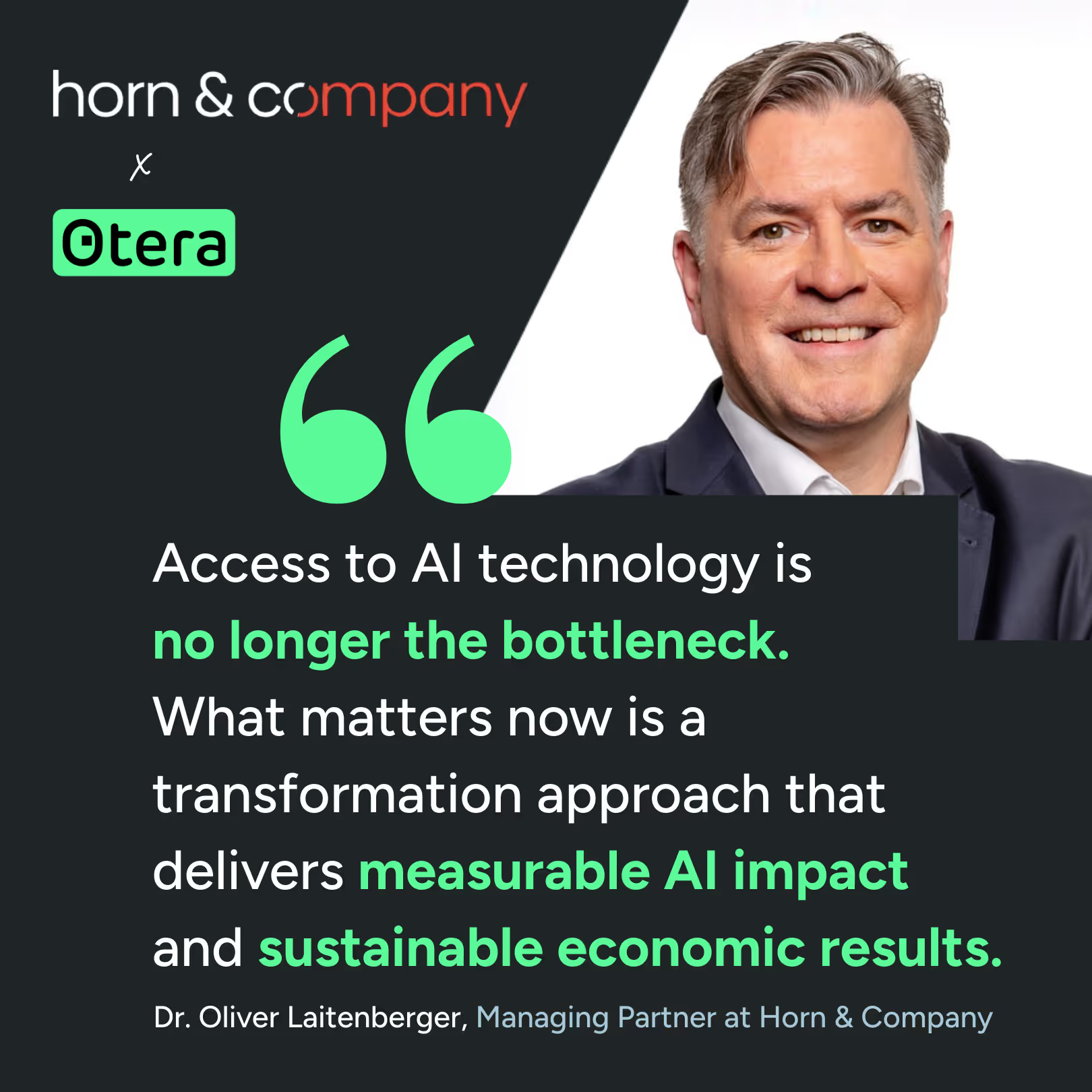
Access to AI technology is no longer the bottleneck.
What's missing in most enterprises is a transformation approach that delivers measurable impact and sustainable economic value. That's the framing Dr. Oliver Laitenberger, Managing Partner at Horn & Company, brings to the partnership:
"Agentic AI is a real game-changer. It's not another tool for point automation. It's an approach that makes technology an integral part of the business and fundamentally changes how value is created." Dr. Oliver Laitenberger, Managing Partner, Horn & Company
On Otera's side, the conviction is that real transformation doesn't come from new tools. It comes from a fundamentally new operating model. As Stefan Engl, CEO and Co-founder of Otera, put it:
"Most enterprises think they can get there by picking a model, writing a prompt, and stitching a few tools together. That won't work. You need specialized agents precise enough that when you chain all operational decisions together, the system still holds. You also need an organization ready to operate around it. Getting both right is the whole game." Stefan Engl, CEO and Co-founder, Otera
What it looks like in practice
The partnership offers enterprises a clear path from assessment to production: an Agentic Viability Assessment backed by a concrete business case, targeted scaling toward an AI-first operating model, or a full implementation program. Assessments are already underway with joint customers.
In existing deployments, processes that previously took days now run in hours, with full auditability at every step. For CEOs and operations leaders with accountability for results, the proposition is direct: measurable operational outcomes on a defined timeline, tracked against KPIs for cycle time, cost, and quality.
Interested in Partnering with Otera? Learn more about the Otera Partner Program →
Press
.png)
From Researching LLMs to Becoming One of Europe's Top 100 Rising AI Startups
Sifted named Otera one of Europe’s top 100 rising AI startups. Alongside that, Sifted named Otera among the top 16 AI workflow automation startups to watch.
Sifted named Otera one of Europe’s top 100 rising AI startups. Alongside that, Sifted named Otera among the top 16 AI workflow automation startups to watch. Forrester, Gartner, and IDC all featured Otera across multiple reports. And the enterprises running autonomous operations in production, Allianz, Siemens, Bayer, expanded their deployments. Not pilots. Production.
.avif)
Why autonomous operations is a different problem
For forty years, enterprise operations ran on fragments: RPA for tasks, APIs for system connections, dashboards for visibility. Bolting AI onto that fragmented foundation amplified the underlying problem rather than solving it. The intelligence layer isn't the gap. The gap is the control layer. The ability to unify agents, orchestration, and governance into a single operational layer that regulators can audit and operations teams can trust.
That's what Otera delivers: autonomous agents that execute end-to-end processes, with the governance enterprises in regulated industries require.
.avif)
2025: the year the proof compounded
Looking back, 2025 made Otera's trajectory unmistakable.
It started with a name. Otera (previously DeepOpinion) marked the moment a company that had spent six years researching and building autonomous agents for regulated, exception-heavy operations finally had a name that matched the ambition: the start of the AUTonomous ERA.
The enterprise deployments deepened. Enterprises that had already moved into production with Otera. Allianz, Siemens, Bayer, Erste, E&, Saab expanded their deployments from claims adjudication to financial document processing to supply chain operations. Agents running core processes at scale, with humans governing exceptions. When organizations of that size run their core operations on autonomous agents, the blueprint stops being a thesis and becomes a fact.
The analyst community caught up. Forrester, Gartner, IDC, and EY all featured Otera across multiple reports in 2025, tracking the same shift enterprise buyers are living: the move from task-level automation to autonomous operations.
Platform usage grew 10x. Partners including Capgemini, Sopra Steria, and Org are now deploying Otera across their enterprise client base. This is what it looks like when a category takes shape: not a single breakthrough moment, but a year where every signal pointed in the same direction.
-transformed.avif)
2026
The enterprises pulling ahead aren't asking how to make their processes faster. They're asking why humans are still handling the parts of work that agents can run. That's the question Otera exists to answer.
2025 proved it works in production, at enterprise scale, across regulated industries.
To every customer who trusted us early, every partner who helped shape the work, and every person on the team who spent this year building what autonomous operations actually look like: thank you.
See you in 2026!
.png)
Gartner Features Otera in the AI Vendor Race for P&C and Life Insurance
Otera’s feature in this report reflects a tremendous shift in how insurers are evaluating AI.
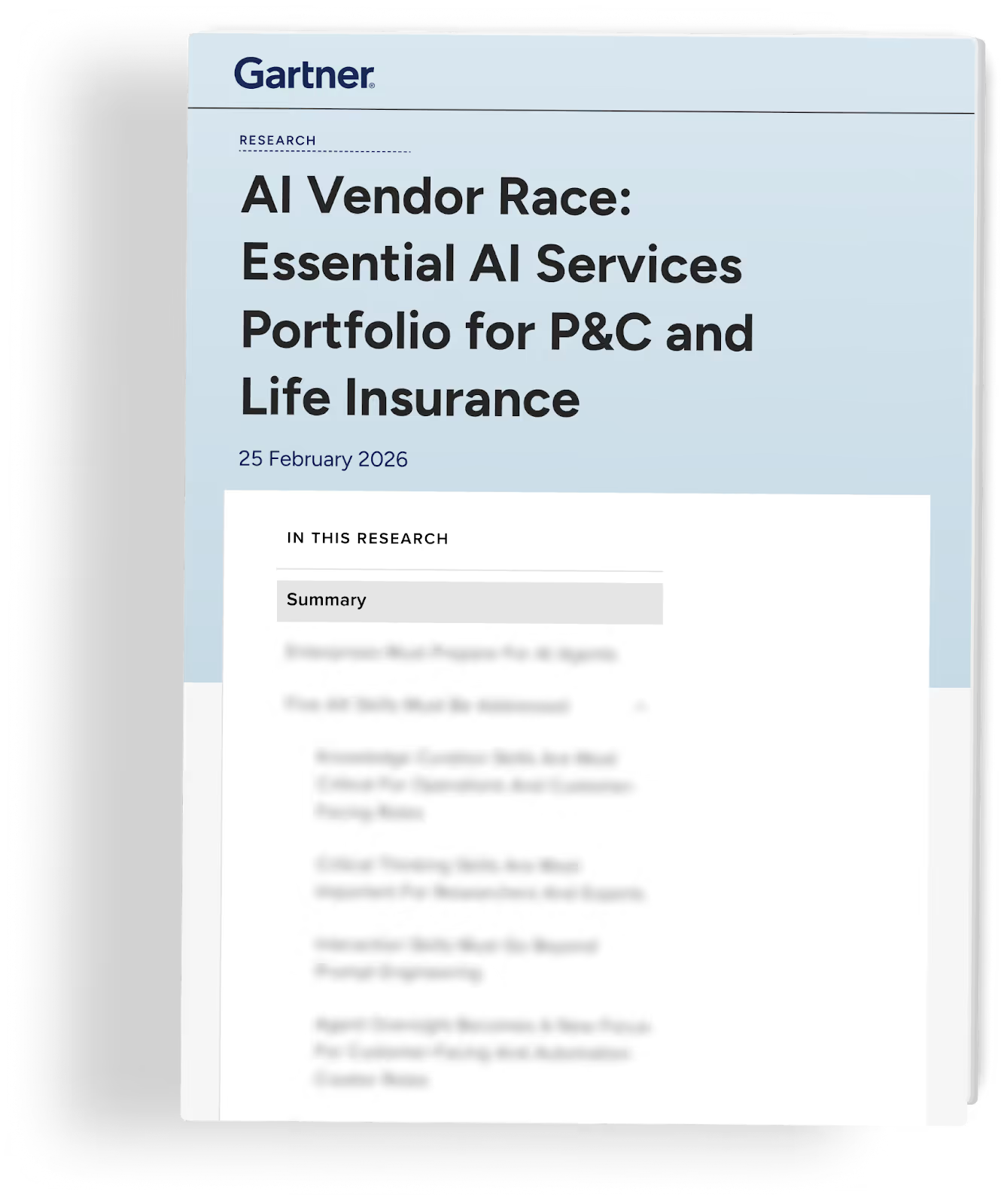
Gartner has published its "AI Vendor Race: Essential AI Services Portfolio for P&C and Life Insurance" report, mapping the AI vendors delivering services across property, casualty, and life insurance operations.
Otera’s feature in this report reflects a tremendous shift in how insurers are evaluating AI. The authors, Arindam Das, David Ackerman, Tom Coshow, and James Ingham, surveyed the vendor landscape at a moment when insurance leaders are moving past experimentation and looking for AI that can run core operations in production.
Why this matters
For insurance CIOs and CDOs evaluating their AI services portfolio, the most repeated question has changed.
It's no longer about whether AI has a role in claims, underwriting, or policy servicing, but about which approaches can handle the complexity of regulated insurance operations at scale: multi-language unstructured inputs, diverse jurisdictional compliance, exception-heavy processes, and the decision-making burden that can make or break company profitability.
That's the environment Otera was purpose-built for:
Autonomous agents that execute claims and insurance operations end-to-end, with full governance, auditability, and human oversight on exceptions, already running in production at Allianz Partners across 30+ countries and at CED processing over 600,000 claims per year.
Continued analyst recognition
This is just the latest in a series of independent analyst recognitions for Otera. Across 2025 and into 2026, Otera has been featured in research from Forrester, Gartner, IDC, and HFS.
What matters to us (and you) is that none of those were paid placements, and they show a consistent pattern: analysts tracking the shift from task-level automation to autonomous operations are finding Otera at the center of that shift, because the production deployments and enterprise clients speak for themselves.
Gartner does not endorse any vendor, product, or service depicted in its research publications, and does not advise technology users to select only those vendors with the highest ratings or other designation. Gartner research publications consist of the opinions of Gartner's research organization and should not be construed as statements of fact. Gartner disclaims all warranties, expressed or implied, with respect to this research, including any warranties of merchantability or fitness for a particular purpose.
Success stories


Stay ahead of Agentic AI Insights
The measurable business impact of intelligent process automation for insurers, based on the Total Economic Impact™ (TEI) framework.

Product Components

The future of enterprise performance.
The work moved fully to machines.
%201.avif)

The only way to achieve Autonomy.
The AI guardrails and oversight that enable autonomy.
%201.avif)

How you win the race to Autonomy.
The time to deploy value.
%201.avif)
Latest from Otera
Otera wins the AI Pioneer category at the insureNXT Innovators Award 2026
A key recognition for Otera's work bringing autonomous claims transformation to global insurers.
Otera has won the AI Pioneer category at the 2026 insureNXT Innovators Award in Cologne.
The award, hosted by Koelnmesse and InsurLab Germany, is the industry's annual recognition for products and services that can reshape insurance over the long term, and this year's edition focused (for the first time) on AI.
The jury, drawn from across insurance, tech, and academia, picked six finalists from a competitive field judged on innovation, scalability, customer value, and contribution to transforming industries. Otera was recognized for Agentic Claims Transformation: Global Automation of Claims Processing.
The insureNXT Innovators Award is an annual award for particularly innovative products, services, business models and projects that can change the insurance industry in the long term.
The work behind the recognition
Otera's claims transformation work runs in production across some of the largest insurance and claims operations in Europe, replacing manual adjudication with autonomous agents that decide and act end-to-end.
CED, a top European claims handling group, now processes 600,000 incoming emails a year in seconds, driving 80% straight-through processing and clearing its backlog entirely. As CEO François Goffinet has put it, this same system could handle 6 million emails the same way.
For Otera's customers, this recognition confirms what they're already seeing every day: autonomous agents are reshaping how regulated work gets done.
About insureNXT
insureNXT is the European insurance industry's annual gathering for innovation, hosted by Koelnmesse and InsurLab Germany in Cologne. The Innovators Award is its annual recognition for products and services with the potential to change the insurance industry over the long term.
About Otera
Otera brings autonomous operations to the enterprises that the world depends on. Transforming mission-critical, highly regulated work that once required humans at every step into governed Autonomous Agents that decide and act end-to-end, freeing enterprises to scale operations without limits. Trusted by Allianz, SAAB, Siemens, and Erste Bank.

Agentic AI Builds Intellectual Capital: Why the Capital Gap Is Widening
The gap between the enterprises that understand this and the ones that do not is already widening.
Most diagnoses of the agentic AI market read it as an early one. Awareness is high, piloting is widespread, and yet very few programs have reached scale. The instinct that follows is to wait. I think that instinct is wrong, and the interventions it produces are wrong with it.
The market is not early, it is misfiring, because much of it has misread what agentic AI on a no-code platform produces. The output is not a tool, and not a deliverable handed over by a partner. It is operational architecture: the workflow logic, the decision structures, and the agent behavior that determine how a business runs. The architecture is built directly by the enterprise, drawn from its own institutional knowledge, and owned outright from the moment it is created.
It is a kind of intellectual capital that prior technology waves could never capture, and that prior knowledge-management efforts never made executable. It compounds with use, it resists reverse engineering, it is your company’s operating DNA as code.
1. The market is not early, it is misfiring.
On the surface, the numbers look like an early-stage market. PwC's AI Performance Study (April 2026), based on 1,217 senior executives across 25 sectors, finds that 74% of AI’s economic value is captured by just 20% of organizations. McKinsey's State of AI (November 2025) reports that 61% of organizations see no measurable EBIT impact from their AI investments. Bain's Technology Report (September 2025) shows that the leaders are at 10 to 25 percent EBITDA gains and are now compounding those gains through agentic systems.
These numbers describe correlation more than causation. The companies pulling ahead are doing several things well at once, and AI is one expression of that broader discipline. What is striking is the structural shape of the gap. The constraint is not awareness, model capability, or technology readiness. It is what happens between pilot and scale, and the friction in that handoff has a specific cause.
2. Productivity tools moved bottlenecks rather than removing them.
The last decade of enterprise technology investment ran on a single premise. Go live with tools that make individual people more capable, and the organization will perform better. The premise was intuitive, and the gains at the individual level were real, but the aggregate P&L impact was rarely commensurate with the investment.
The bottleneck was never the model. It was the architecture the model was dropped into.
Each successive wave made the people inside the system more capable, but it left the system itself intact. The analyst completed the work faster, the report landed sooner on the next desk, and the bottleneck simply moved one step downstream. McKinsey's State of AI (November 2025) is direct on the mechanism. Of all 25 organizational attributes tested, workflow redesign has the single largest effect on whether AI investments deliver EBIT impact.
3. The output is intellectual capital that prior waves could not capture.
For thirty years, every enterprise technology wave has shared one commercial structure. A vendor builds a platform, a partner packages it into an implementable solution, and an enterprise buys the result. The output is always a deliverable: scoped, priced, handed over, replicated. What an agentic platform produces, when the build barrier has been removed, does not fit that pattern, because the source material lives inside the company doing the building rather than at the vendor.
The right name for what this produces is intellectual capital, in the established sense the term has carried in business literature for decades. Intellectual capital refers to the intangible assets that drive competitive advantage, the knowledge and judgment that live, traditionally, in the heads of experienced people and rarely make it into systems that survive them. What is genuinely new is that this kind of intellectual capital can now be encoded, executed, and compounded, rather than walking out the door when the people who hold it leave.
Two fair skeptical questions follow:
The first is whether this is just knowledge management 2.0. The earlier knowledge-management movement captured records of decisions, the artifacts of what experts had already done.
It could not capture the decision-making itself, because decision-making lives in the act, not in the record. Agentic platforms encode the act.
The second is whether this is a repackaging of low-code, BPM, or workflow automation, all of which have promised to capture institutional knowledge for two decades. The technical distinction is specific. Those tools required either explicit branching rules or process flows the expert could already articulate, and they captured the describable portion of what an expert knew, which has never been the part that mattered most. What agentic platforms make possible is that domain experts can encode judgment under uncertainty: the pattern-matching, the exception logic, and the contextual reasoning that prior tools could not represent because that knowledge cannot be expressed as if-then rules. That is the technical reason the asset class is new.
PwC's AI Agent Survey (May 2025) makes the conversion problem visible from the operating model side. Fewer than half of companies adopting AI agents are fundamentally rethinking their operating models (45%) or redesigning processes around those agents (42%). The rest are trying to purchase a solution to a problem that cannot be solved by purchasing.
4. Tacit knowledge becomes executable when the expert builds.
Consider specialty claims at a multi-line insurer. The senior handler who triages incoming files makes dozens of decisions in the first review, including severity coding, reserve estimation, fraud flags, attorney-involvement risk, and whether the claim warrants an immediate field investigation or can be handled at the desk.
Most of these decisions are tacit. There is rarely a document anywhere that says, "if the loss description matches pattern A, the claimant is represented within fourteen days, and the policy limits are above five hundred thousand dollars, escalate to a senior adjuster within forty-eight hours." The senior handler simply knows. The handler also knows the dozen exception patterns that override the rule, the rural geographies that change the calculus, and the carrier-of-record histories that suggest something other than what the file appears to say.
In the prior model, this knowledge sat in the senior handler’s head. New hires shadowed for two years to absorb fragments of it. When the senior handler retired, two years of shadow training began again.
On an agentic platform, the senior handler builds the triage workflow directly. The rules they would apply, the exceptions they would catch, and the escalation paths they would trigger all go into the agent that processes the next claim. The agent does not replace the handler’s judgment; it executes that judgment on every file the handler will not personally see. When the loss environment shifts, the same handler updates the workflow themselves. The institutional knowledge no longer retires with the people who hold it.
The example is illustrative rather than citational, but the shape repeats wherever experienced operators carry decision logic that has resisted documentation: underwriting, exception handling in supply chains, complex case management in healthcare, and dispute resolution in payments.
5. The asset forms only with governance, integration, and willing experts.
Intellectual capital of this kind does not form on its own. From the autonomous operations that we've gone live with, three conditions have to hold for it to form well.
Governance has to keep pace with build velocity.
A no-code platform that lets hundreds of domain experts build agents without architectural review, model risk approval, audit trails, or explainability standards is not a moat, it is a board-level liability.
The organizations getting this right run agent governance with the same discipline they apply to model risk management: change-approval workflows, version control, escalation criteria for autonomous decisions, and clear accountability for the logic each agent encodes.
Existing data and ML investments do not get replaced, they get connected. Agentic platforms sit on top of the existing stack rather than displacing it. Agents call the models that already exist, those models score features from the feature store, and the feature store draws from the data warehouse the company has already invested in. The platform finally connects that enterprise cloud infrastructure to operational decisions in a way that previously required custom integration for every use case.
The asset only forms where the domain expert is available, willing, and equipped to build. Some decisions resist formalization, including the high-stakes, low-volume judgments that depend on relationships, context, or political read. Some experts can do the work but cannot describe how they do it. Some organizational cultures reward an expert’s exclusive grip on knowledge rather than its release. Where any of these conditions hold, agentic platforms produce automation rather than intellectual capital, and the right move is something other than the one this article is about. Admitting that openly is part of taking the asset class seriously.
6. Partners closer to the build edge matter more, not less.
The partner and alliance conversation is shifting, and the cause is not Partner ineffectiveness, it is that the asset itself has changed shape.
The traditional engagement model formed around implementation as the scarce capability, anchored to labor-intensive build, multi-year programs, and integration complexity. Agentic platforms change the shape of the deliverable, and the shape of the engagement with it. The output is client-owned intellectual capital, embedded in operations and compounding over time. That value is not captured at an implementation handoff, the way value used to be captured. It is created continuously through the execution of the work itself.
Advisory firms occupy a different position. The front end of an agentic deployment, including operating model diagnosis, workflow prioritization, governance design, and change leadership, sits squarely within advisory capability. That work becomes more important. What changes is the next step. The build itself, where institutional knowledge is encoded into the agent, happens inside the enterprise.
Advisory firms shape the system. The enterprise builds the asset.
In previous waves, enterprises waited for partners to build vertical templates. In agentic AI, the most advanced organizations are increasingly building those templates themselves, not from preference for in-house work, but because the asset they are creating cannot be separated from their own operational logic. The partners that move closest to that build edge will be the ones that matter most in the next phase of the market.
7. A capital gap compounds, and three questions tell you where you stand.
The divergence between leaders and laggards has already begun, and the structure of it is unfamiliar. In prior waves, late movers could close the gap by purchasing the same tools and engaging the same partners. The agentic AI case breaks that logic. A competitor can reverse-engineer your workflow architecture, but they cannot reverse-engineer the institutional knowledge encoded into it. That knowledge comes from your specific people, your specific process history, and your specific operational reality, and it is not transferable to anyone outside the company that produced it.
PwC's 2026 AI Performance Study shows leaders generating 7.2 times more revenue and efficiency gains from AI than the average competitor. That is a directional signal, not a deterministic claim, but the gap is widening fastest among organizations that treat these deployments as capital formation rather than as faster tooling.
For an executive team running agentic AI inside an enterprise, three diagnostic questions matter. They matter most when momentum is high, not after a program has stalled.
What happens when you make an existing workflow autonomous? If left unchanged, its inefficiencies are simply encoded into a system that becomes harder to evolve than the manual process it replaced. The organizations seeing compounding returns avoid this by starting with the current process, then redesigning it as the system begins to operate.
Who carries the institutional knowledge this deployment depends on, and are they building, or being consulted? When the answer is "being consulted," the most valuable knowledge in the room is being translated rather than encoded. That is the moment the asset stops forming.
Are we building intellectual capital, or completing a project? A project has a completion date and a handoff. Intellectual capital has an owner, a roadmap, and a compounding curve. Most organizations choose between these two framings by default rather than by design, and the default choice almost always produces project outcomes: bounded, depreciating, replaceable.
What is missing is not belief. It is a clear-eyed reading of what is being built, and an honest reckoning with what it takes to build it well.
The technology is ready, the awareness is universal, and the conditions for action exist. What remains is the willingness to treat agentic AI as capital formation, and to accept that the work itself cannot be outsourced, because the source material lives inside the company doing the building.
The gap between the organizations that make that shift and the ones that do not is a capital gap, and capital gaps compound rather than closing gradually.
Otera and TXP partner to deliver out-of-the-box autonomous AI agents to the UK mid-market
We’re combining our AI agent platform and TXP’s solutions engineering expertise to accelerate autonomous operations
TXP, the systems integrator specializing in tech consulting, development and resourcing, has announced a partnership with Otera, the autonomous operations platform, to bring production ready AI decision agents to the UK market.
With this partnership, TXP joins Otera’s implementation partners in the UK in a collaboration that combines Otera’s platform, which goes live with AI decision agents to run full processes end-to-end, with TXP’s solutions engineering expertise and deep understanding of complex business processes.
Built for regulated, process-heavy operations
The partnership will focus on bringing autonomous operations to mid-market organizations across a range of sectors, from financial services and insurance to healthcare and the public sector.
Using the Otera platform, organizations can rapidly go live with agentic AI workflows using a no/low-code interface. The joint offering from Otera and TXP will be particularly beneficial for those organizations that lack the in-house skills and resources required to build and go live with AI agents effectively.
“Autonomous operations shouldn't be a privilege of the largest enterprises. TXP's solutions engineering excellence and deep understanding of business operations make it the ideal partner to help bring autonomous operations to the UK mid-market. We think this presents a significant opportunity, particularly as more and more organizations look to build agentic-first operations, supported by full oversight, auditability and governance guardrails.” Hendrick Leitner, Chief Partnerships Officer at Otera
In highly regulated sectors such as banking and insurance, where demand for compliant, end-to-end process execution is particularly high, Otera orchestrates multiple AI agents within a single, seamless workflow. This enables organizations to execute processes end-to-end, from intake to resolution, with humans governing only true exceptions.
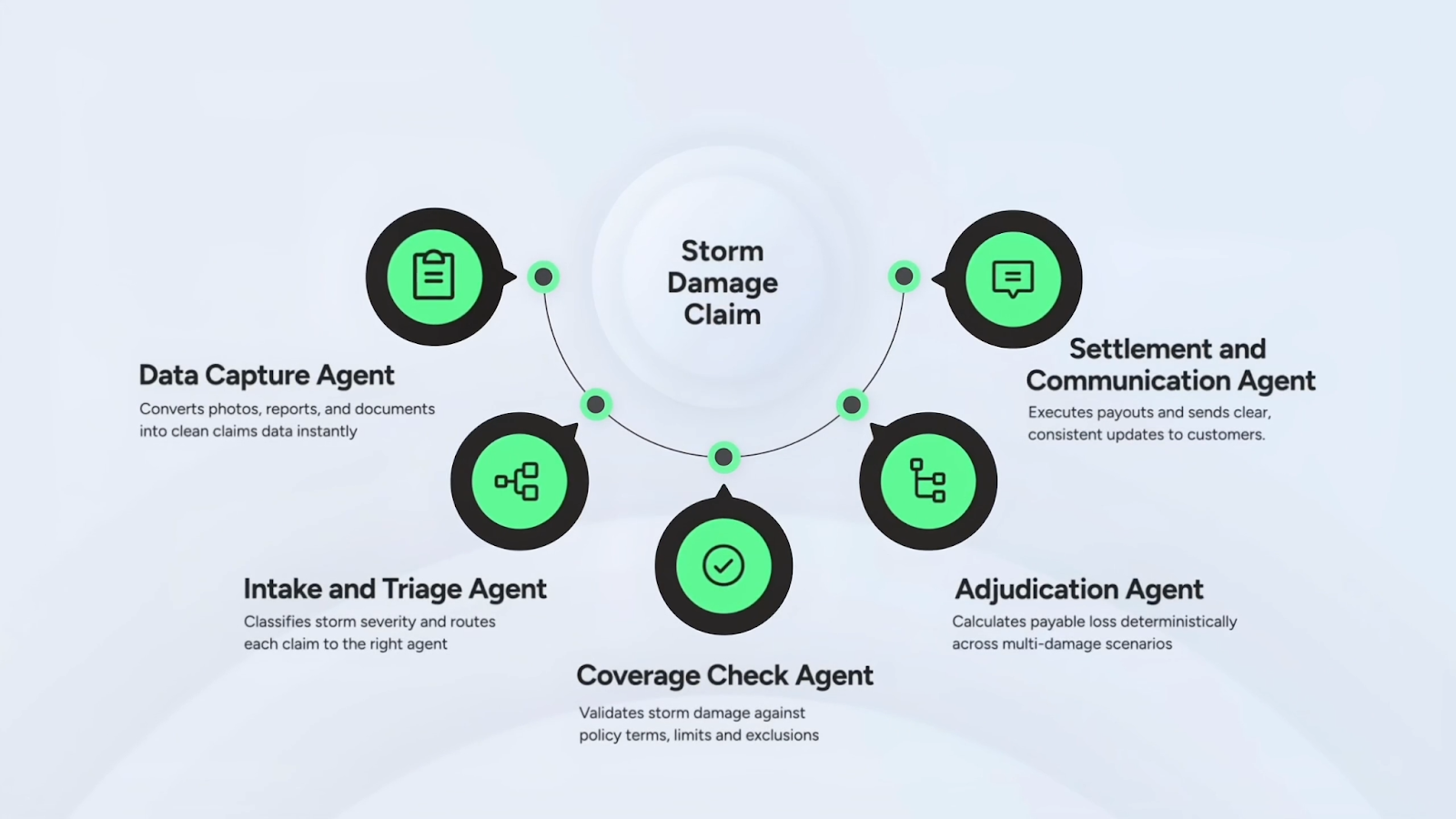
For example, in claims processing, task-specific agents work together to analyze a claim, cross-reference it against the customer’s policy, manage settlements, communicate with the customer and issue payment.
We’re really excited to be partnering with Otera as it expands the customer base for its autonomous operations platform.
Many agentic AI projects struggle to get out of the starting blocks, due to a lack of resources to build and maintain agents effectively. The combination of Otera’s proven platform and TXP’s solutions engineering expertise means that organizations can responsibly roll out and realize the benefits of AI agents in weeks, not quarters. Tim Hurst, Chief Operations Officer at TXP
About TXP
TXP (Technology x People) is a UK leading digital transformation business, delivering consulting, development and technology resourcing solutions to a diversified blue-chip client base. The West Midlands based company currently works across the public and private sectors, providing legacy modernization services, custom software development and IT resource augmentation.
About Otera
Otera brings autonomous operations to the enterprises that the world depends on. Transforming mission-critical, highly regulated work that once required humans at every step into governed Autonomous Agents that decide and act end-to-end, freeing enterprises to scale operations without limits. Trusted by Allianz, SAAB, Siemens, Hannover Re and Erste Bank.
Gartner Features Otera in the AI Vendor Race for P&C and Life Insurance
Otera’s feature in this report reflects a tremendous shift in how insurers are evaluating AI.
Gartner has published its "AI Vendor Race: Essential AI Services Portfolio for P&C and Life Insurance" report, mapping the AI vendors delivering services across property, casualty, and life insurance operations.
Otera’s feature in this report reflects a tremendous shift in how insurers are evaluating AI. The authors, Arindam Das, David Ackerman, Tom Coshow, and James Ingham, surveyed the vendor landscape at a moment when insurance leaders are moving past experimentation and looking for AI that can run core operations in production.
Why this matters
For insurance CIOs and CDOs evaluating their AI services portfolio, the most repeated question has changed.
It's no longer about whether AI has a role in claims, underwriting, or policy servicing, but about which approaches can handle the complexity of regulated insurance operations at scale: multi-language unstructured inputs, diverse jurisdictional compliance, exception-heavy processes, and the decision-making burden that can make or break company profitability.
That's the environment Otera was purpose-built for:
Autonomous agents that execute claims and insurance operations end-to-end, with full governance, auditability, and human oversight on exceptions, already running in production at Allianz Partners across 30+ countries and at CED processing over 600,000 claims per year.
Continued analyst recognition
This is just the latest in a series of independent analyst recognitions for Otera. Across 2025 and into 2026, Otera has been featured in research from Forrester, Gartner, IDC, and HFS.
What matters to us (and you) is that none of those were paid placements, and they show a consistent pattern: analysts tracking the shift from task-level automation to autonomous operations are finding Otera at the center of that shift, because the production deployments and enterprise clients speak for themselves.
Gartner does not endorse any vendor, product, or service depicted in its research publications, and does not advise technology users to select only those vendors with the highest ratings or other designation. Gartner research publications consist of the opinions of Gartner's research organization and should not be construed as statements of fact. Gartner disclaims all warranties, expressed or implied, with respect to this research, including any warranties of merchantability or fitness for a particular purpose.

How a Swiss Insurer Built Claims Operations That Scale with Any Crisis
What this insurer built is not a one-off automation project. It is an operating system that scales with demand regardless of what that demand looks like.
A claims operation built for normal times breaks during every crisis. The question isn’t whether a flood or storm will overwhelm the team, it’s whether the operation is designed to absorb that pressure or buckle under it. One of the world’s leading insurers decided to answer that question by replacing its manual claims model with autonomous operations. The result is an operation that now scales to any volume, in any market, without adding headcount.
This video tells that story:
The structural problem every large claims operation hits
This major Swiss insurer processes millions of cases per year across multiple countries. That scale exposes four structural tensions that traditional automation cannot resolve:
- Volume and volatility. Storm seasons and mass damage events arrive without warning, precisely when response speed matters most. The operation that handles 10,000 cases a week needs to handle 100,000 without degrading.
- Regulatory and product complexity. A motor claim in Spain and a liability dispute in Germany require different rules, different languages, and different product-line logic. Uniform precision across all of them is not optional.
- Linear cost scaling. When more cases required more people, margin expansion hit a structural ceiling. The growth model and the cost model were locked together.
- Decision quality under pressure. Whether at normal capacity or in the middle of a crisis, every claim required a consistent, auditable outcome. That standard does not flex.
Legacy automation could not solve this. Judgment calls, cross-referencing, and end-to-end execution from first notice of loss through settlement and payment still fell to human teams. When a crisis hit, the backlog grew faster than any team could clear it.
Autonomous agents running claims end-to-end
The insurer took a different approach with Otera. Rather than layering automation tools on top of the existing model, they deployed autonomous AI agents that now run claims operations end-to-end.
When a customer reports storm damage through their portal, specialized agents immediately take over: one validates the policy, another assesses the damage, another cross-checks against fraud patterns. These agents collaborate to settle the claim, trigger payment, and notify the customer… all in real time.
Human teams step in only for genuine edge cases that require judgment and empathy. Everything else flows straight through.
An new operating system, not a point solution
What this insurer built is not a one-off automation project. It is an operating system that scales with demand regardless of what that demand looks like.
The shift shows up differently for each stakeholder:
- For policyholders, a claim filed after a storm no longer enters a queue measured in weeks. Resolution arrives immediately. That is the difference between a company that processes your claim and one that is there when you actually need them.
- For claims teams, the daily work shifts away from classification, data entry, and routine settlements toward the cases that genuinely require judgment: complex disputes, sensitive situations, fraud investigation.
- For the organization, a mass damage event no longer triggers emergency hiring and months of backlog recovery. The operation absorbs the spike.
The architecture is not scoped to one product line or geography. The same autonomous agents that settle a storm damage claim in one market run motor, liability, and health claims across entirely different regulatory environments. That composability is what separates an operating model from a point solution: a point solution fixes one workflow, Otera changes how the entire claims organization runs, from this quarter forward.
This is the shift underway across the industry: from claims operations constrained by how many people you can hire, to operations that scale with demand. The insurers pulling ahead are not the ones automating faster. They are the ones that stopped automating and started operating autonomously.
Otera and Horn & Company Partner to Scale Autonomous Operations in Regulated Enterprises
We are partnering to help enterprises build autonomous operations in regulated industries from assessment through to agents running in production.
The overwhelming majority of large enterprises have started piloting agentic AI, but fewer than 15% have successfully scaled beyond departmental experiments.
The gap between a working pilot and an operating model that runs autonomously across the business is where most initiatives stall. Not because the technology fails. Because the transformation infrastructure to embed it was never built.
That gap has two sides. Most consulting engagements diagnose the organizational problem but have no production-ready autonomous agents to go live with. Most software vendors have the agents but can't drive the organizational transformation required to make autonomy stick. Enterprises get one or the other. Rarely both.
This partnership is built around that gap. Otera and Horn & Company, a management consultancy with deep expertise in banking, insurance, manufacturing, and automotive, are partnering to help enterprises build autonomous operations in regulated industries from assessment through to agents running in production.
What each side brings
Horn & Company brings transformation architecture: executive alignment, AI-strategy, AI-first operating model design, and governance structures that make autonomous operations sustainable and auditable. With around 250 consultants across Düsseldorf, Berlin, Frankfurt, Munich, Singapore, Vienna, Zürich, and other offices, they work at the intersection of strategy and measurable P&L impact.
Otera brings the autonomous AI agents that turn operations into end-to-end autonomous processes. The platform is purpose-built for regulated, mission-critical environments where decision quality, auditability, and compliance are non-negotiable. It sits on top of your enterprise cloud infrastructure with no core system changes required, executing entire processes autonomously while the business retains strategic oversight. Every agent decision is fully traceable and explainable.
Why this matters now
Access to AI technology is no longer the bottleneck.
What's missing in most enterprises is a transformation approach that delivers measurable impact and sustainable economic value. That's the framing Dr. Oliver Laitenberger, Managing Partner at Horn & Company, brings to the partnership:
"Agentic AI is a real game-changer. It's not another tool for point automation. It's an approach that makes technology an integral part of the business and fundamentally changes how value is created." Dr. Oliver Laitenberger, Managing Partner, Horn & Company
On Otera's side, the conviction is that real transformation doesn't come from new tools. It comes from a fundamentally new operating model. As Stefan Engl, CEO and Co-founder of Otera, put it:
"Most enterprises think they can get there by picking a model, writing a prompt, and stitching a few tools together. That won't work. You need specialized agents precise enough that when you chain all operational decisions together, the system still holds. You also need an organization ready to operate around it. Getting both right is the whole game." Stefan Engl, CEO and Co-founder, Otera
What it looks like in practice
The partnership offers enterprises a clear path from assessment to production: an Agentic Viability Assessment backed by a concrete business case, targeted scaling toward an AI-first operating model, or a full implementation program. Assessments are already underway with joint customers.
In existing deployments, processes that previously took days now run in hours, with full auditability at every step. For CEOs and operations leaders with accountability for results, the proposition is direct: measurable operational outcomes on a defined timeline, tracked against KPIs for cycle time, cost, and quality.
Interested in Partnering with Otera? Learn more about the Otera Partner Program →
From Researching LLMs to Becoming One of Europe's Top 100 Rising AI Startups
Sifted named Otera one of Europe’s top 100 rising AI startups. Alongside that, Sifted named Otera among the top 16 AI workflow automation startups to watch.
Sifted named Otera one of Europe’s top 100 rising AI startups. Alongside that, Sifted named Otera among the top 16 AI workflow automation startups to watch. Forrester, Gartner, and IDC all featured Otera across multiple reports. And the enterprises running autonomous operations in production, Allianz, Siemens, Bayer, expanded their deployments. Not pilots. Production.
Why autonomous operations is a different problem
For forty years, enterprise operations ran on fragments: RPA for tasks, APIs for system connections, dashboards for visibility. Bolting AI onto that fragmented foundation amplified the underlying problem rather than solving it. The intelligence layer isn't the gap. The gap is the control layer. The ability to unify agents, orchestration, and governance into a single operational layer that regulators can audit and operations teams can trust.
That's what Otera delivers: autonomous agents that execute end-to-end processes, with the governance enterprises in regulated industries require.
2025: the year the proof compounded
Looking back, 2025 made Otera's trajectory unmistakable.
It started with a name. Otera (previously DeepOpinion) marked the moment a company that had spent six years researching and building autonomous agents for regulated, exception-heavy operations finally had a name that matched the ambition: the start of the AUTonomous ERA.
The enterprise deployments deepened. Enterprises that had already moved into production with Otera. Allianz, Siemens, Bayer, Erste, E&, Saab expanded their deployments from claims adjudication to financial document processing to supply chain operations. Agents running core processes at scale, with humans governing exceptions. When organizations of that size run their core operations on autonomous agents, the blueprint stops being a thesis and becomes a fact.
The analyst community caught up. Forrester, Gartner, IDC, and EY all featured Otera across multiple reports in 2025, tracking the same shift enterprise buyers are living: the move from task-level automation to autonomous operations.
Platform usage grew 10x. Partners including Capgemini, Sopra Steria, and Org are now deploying Otera across their enterprise client base. This is what it looks like when a category takes shape: not a single breakthrough moment, but a year where every signal pointed in the same direction.
2026
The enterprises pulling ahead aren't asking how to make their processes faster. They're asking why humans are still handling the parts of work that agents can run. That's the question Otera exists to answer.
2025 proved it works in production, at enterprise scale, across regulated industries.
To every customer who trusted us early, every partner who helped shape the work, and every person on the team who spent this year building what autonomous operations actually look like: thank you.
See you in 2026!

Otera (Previously DeepOpinion) Expands Agentic Automation Leadership, Featured in Leading Analyst Firm’s AI-Enabled Workplace Report
Otera's Inclusion in the IDC Market Glance Arrives as Enterprises Move from Task Automation to Autonomous Operations at Scale.
The enterprises reshaping their industries right now are not optimizing processes. They are replacing them entirely with autonomous operations, where specialized AI agents execute end-to-end work and humans govern by exception. That shift is no longer theoretical. Otera (previously DeepOpinion) has been included in IDC's Market Glance: AI-Enabled Workplace, 3Q25 (Doc #US53762125, August 2025), a recognition that arrives as more enterprises move beyond task-level automation toward fully autonomous process execution.
For insurers, banks, and manufacturers managing billions in operational spend, the implications are structural. When claims handling, procure-to-pay, or customer service processes run autonomously from intake to resolution, the result is not incremental efficiency. It is a fundamentally different cost structure, a different risk posture, and a different capacity model. Enterprises deploying Otera across these workflows are reaching straight-through resolution without manual intervention, while maintaining full compliance and auditability in some of the most heavily regulated operating environments in the world.
"The world has outgrown islands of automation," said Stefan Engl, CEO at Otera. "Operations that once required hundreds of specialists now run autonomously, with humans setting the rules and intervening only where true judgment is required. That is the shift we see playing out in production every day across insurance, banking, and manufacturing."
What Separates Autonomous Operations from Traditional Automation
Unlike tools that digitize fragments of a process and still leave humans to reconcile the gaps, an autonomous operations model changes the underlying logic of how work gets done.
• End-to-End Execution, Not Task Assistance. Entire processes run from first input to final outcome without manual handoffs between stages or systems.
• Cross-Departmental Scope. Claims, procurement, customer service, and finance workflows operate under a single orchestration layer rather than in disconnected silos.
• Native System Interoperability. ERP, CRM, BPM, and legacy environments are unified so that agents operate across the full technology estate, not within one application at a time.
• Governance by Design. Confidence-based routing, audit trails, and AI guardrails ensure that autonomous execution stays within governed parameters, critical for regulated industries where a single compliance failure can carry eight-figure consequences.
The pattern playing out across Otera's enterprise deployments points to a broader inflection. AI is not simply making existing work faster. It is restructuring how enterprises allocate human attention, operational capital, and risk.
To read IDC Market Glance: AI-Enabled Workplace, click here.
About Otera
Otera brings autonomy to the operations the world depends on. We transform mission-critical processes into governed AI systems that decide and act end-to-end, freeing enterprises to grow without limits. Trusted by Allianz, Siemens, Bayer, SAAB, and Hannover Re.
Source: IDC, IDC Market Glance: AI-Enabled Workplace, 3Q25, Doc #US53762125, August 2025.

Otera Mentioned in 2025 Gartner® Emerging Tech: Top-Funded Startups for Domain-Specialized Agentic AI
Enterprise investment is converging on a specific class of AI: systems designed to perform work, not assist with it.
Enterprise investment is converging on a specific class of AI, systems designed not to assist with work, but to perform it. Otera (previously DeepOpinion) has been mentioned in Gartner's report, "Emerging Tech: Top-Funded Startups for Domain-Specialized Agentic AI." The mention comes as a growing number of global enterprises transition from fragmented automation tools toward autonomous operations, where specialized AI agents execute entire business processes end-to-end.
This transition represents a fundamentally different operating model. Traditional automation digitizes individual steps while still relying on humans to reconcile exceptions, stitch outputs across systems, and make judgment calls at every turn. Autonomous operations invert that model. AI agents execute the process. Humans set the rules and intervene only where genuine judgment is required.
Otera's platform is built around this distinction. It goes live with specialized AI agents across complex, multi-step processes such as claims handling, procure-to-pay, and customer service, orchestrating work across ERP, CRM, BPM, and legacy systems from intake to resolution.
"The shift we see across our client base is structural, not incremental," said Stefan Engl, CEO and Co-Founder of Otera. "Enterprises are not optimizing their existing operations. They are replacing them with autonomous processes where AI agents handle the work and humans govern by exception. That is the model the next generation of enterprise operations will run on."
Otera operates in production at enterprises including Allianz, Siemens, and Hannover Re, spanning insurance, banking, and manufacturing. These autonomous operations handle millions of complex cases annually, delivering operational transformation that reshapes how entire business functions run rather than reducing cost at the margins.
The 2025 Gartner® Emerging Tech: Top-Funded Startups for Domain-Specialized Agentic AI is available to Gartner clients here.
Gartner Disclaimer
Gartner does not endorse any vendor, product or service depicted in its research publications, and does not advise technology users to select only those vendors with the highest ratings or other designation. Gartner research publications consist of the opinions of Gartner’s research organization and should not be construed as statements of fact. Gartner disclaims all warranties, expressed or implied, with respect to this research, including any warranties of merchantability or fitness for a particular purpose.
.avif)
Otera and Org partner to bring Autonomous Operations to UK & Ireland enterprises
A new alliance pairs Otera's autonomous operations platform with Org's enterprise transformation expertise to reshape how regulated industries run.
Otera (previously DeepOpinion), the category-defining platform for Autonomous Enterprise operations, has announced a strategic partnership with Org, a leading transformation consultancy behind some of Europe’s most complex enterprise change programs. This collaboration brings autonomous, outcome-driven operations to the center of enterprise execution starting with the UK and Ireland.
As legacy automation tools struggle to keep pace with unstructured data and complex workflows, enterprises are under pressure to move beyond brittle bots. This partnership addresses that urgency head-on by combining Otera’s agentic-native platform with Org’s transformation expertise to deliver fast, controlled, and scalable automation that thinks, learns, and acts independently.
“Automation has outgrown its rule-based roots,” said Derek O’Connell, CEO at Org. “With Otera, we’re helping our clients unlock a new paradigm of autonomous execution that delivers outcomes at speed, without compromise.”
Real-World Results, Already in Motion
The partnership is already delivering value across initial rollouts in Europe’s most tightly regulated markets. Early adopters are achieving up to 90%+ straight-through processing on complex, high-volume processes without any training data, and with full auditability and human-in-the-loop control where needed.
“Org understands the strategic ‘why’ behind enterprise change,” said Stefan Engl, CEO at Otera. “Together, we’re accelerating the adoption of Agentic AI and helping clients go live in weeks, not quarters, while maintaining total control and traceability.”
The alliance includes co-designed frameworks, joint go-to-market initiatives, and integrated delivery teams. That gives enterprise clients a turnkey path to intelligent automation across workflows like claims handling, underwriting, customer onboarding, and more.
About Otera
Otera is the operating system for autonomous enterprises. Its platform deploys specialized AI agents that collaborate under governance to run complex business processes end-to-end. Trusted by global leaders including Allianz, Siemens, Hannover Re, e&, and Bayer.
About Org
Org helps organisations achieve transformational change. Our team has sat in your chair and walked in your shoes, bringing deep understanding to develop customised solutions that deliver measurable outcomes. By combining the power of people and technology, we accelerate time to value. Org is part of Org Group, a global leader in Organisational Engineering for over 30 years. With a team of 3,000 professionals across 19 offices in 12 countries, Org Group has helped more than 5,000 clients evolve and grow through talent, technology, and customer experience solutions. The Group delivers three core solutions to businesses worldwide: Advise. Manage. Transform. Learn more at www.thisisorg.com
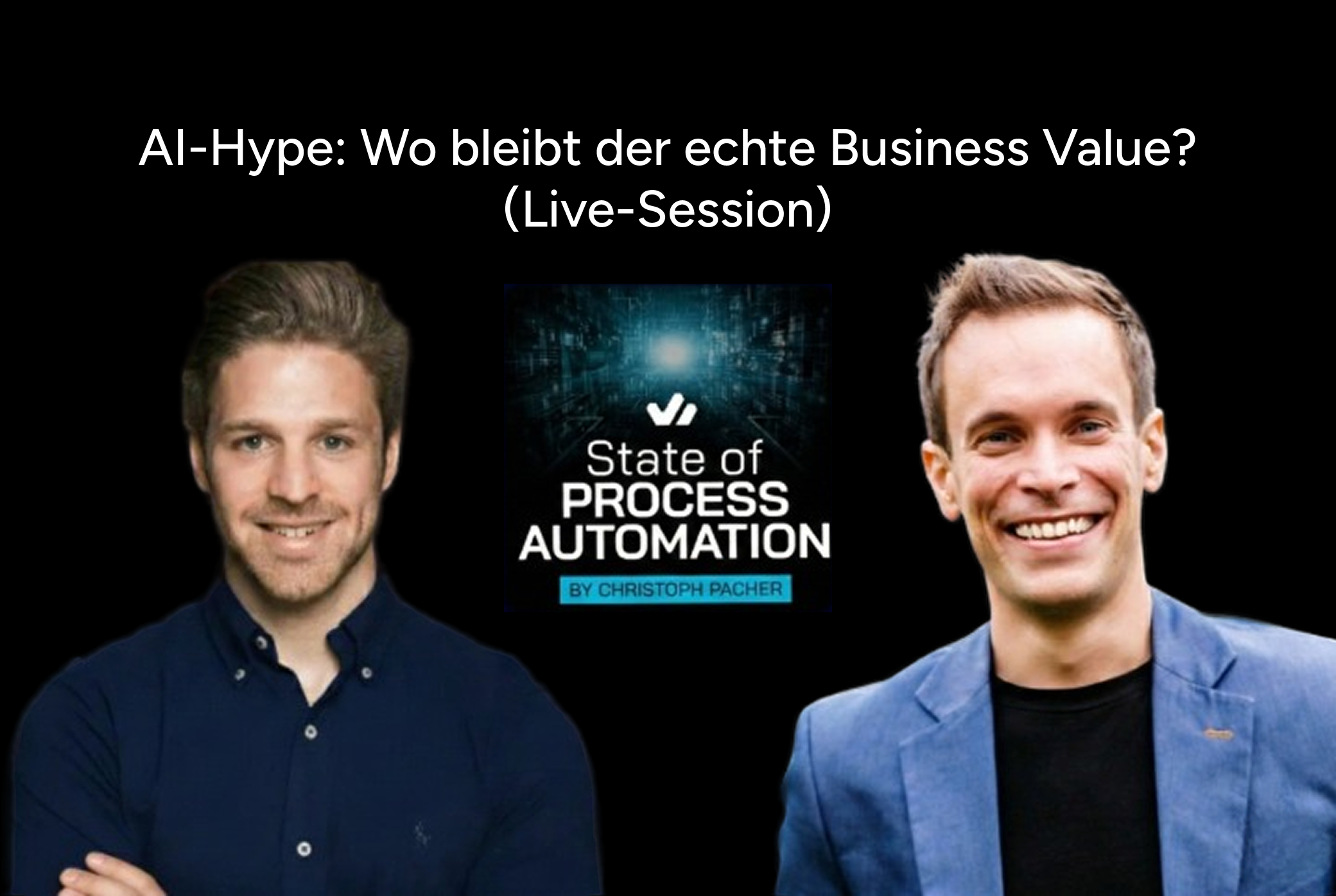
State of Process Automation Live Session: AI Hype vs. Business Value
Stefan Engl and industry practitioners examined the operational foundations that determine whether a deployment generates tens of millions in value or stalls at the proof-of-concept stage.
Most enterprises now accept that generative AI will reshape operations. The harder question, and the one that separates leaders from followers, is where it delivers measurable impact at enterprise scale and where it remains an expensive experiment. Earlier this month, the State of Process Automation podcast brought together practitioners to pressure-test the hype with operational reality.
Hosted by Christoph Pacher, founder of State of Process Automation, the session featured Stefan Engl, CEO and Co-Founder of Otera (previously DeepOpinion); Enver Cetin, Senior Manager Intelligent Automation at Ciklum; and Pedro Berrocosso, Founder and Senior Advisor at AccelerIQ GmbH. The conversation moved past surface-level enthusiasm for AI and into the operational foundations that determine whether a deployment generates tens of millions in value or stalls at the proof-of-concept stage.
"Generative AI has great power, which one should use. One needs certain frameworks around it, so that it doesn't produce more issues, but one can actually produce valuable results with it today." Stefan Engl, CEO and Co-Founder of Otera
Key Takeaways
• Governance determines outcomes, not the model itself.
The panel agreed that enterprises fail to capture value not because the underlying AI is inadequate, but because they deploy it without the operational guardrails to make it reliable. In high-stakes, regulated environments, ungoverned AI generates risk faster than it generates returns.
• Terminology confusion stalls executive decision-making.
Panelists discussed how imprecise language across the industry makes it harder for senior leaders to evaluate vendors, set realistic expectations, and distinguish genuine autonomous capabilities from incremental automation wrapped in new branding.
• Readiness work is not optional.
Organizations that rush to deploy generative AI without first addressing data quality, process clarity, and organizational alignment consistently underperform. The panel emphasized that the companies achieving the largest results treat operational readiness as a prerequisite, not a parallel workstream.
• The highest-impact use cases involve end-to-end process transformation.
Organizations seeing the greatest returns are not automating isolated tasks. They are rethinking entire operational workflows, particularly in document-heavy, decision-intensive processes where the gap between manual operations and autonomous execution is widest.
• Regulated industries are leading, not lagging.
Insurance, banking, and government were highlighted as sectors where generative AI is delivering the most tangible business impact today, precisely because the complexity and volume of their processes create the conditions where autonomous operations unlock the most value.
Timestamps
• (00:01) Introduction to the live session and the topic of AI hype.
• (04:06) How the guest speakers perceive the AI hype and define key AI terms.
• (14:20) Why ChatGPT results are getting worse and challenges with the technology.
• (16:44) Homework companies must do before implementing AI and mistakes to avoid.
• (41:48) Use cases where generative AI is observed to bring the most value.
The full conversation is available on the State of Process Automation podcast and is well worth the time for any operations or technology leader evaluating where AI fits within their enterprise operating model. Find it here.
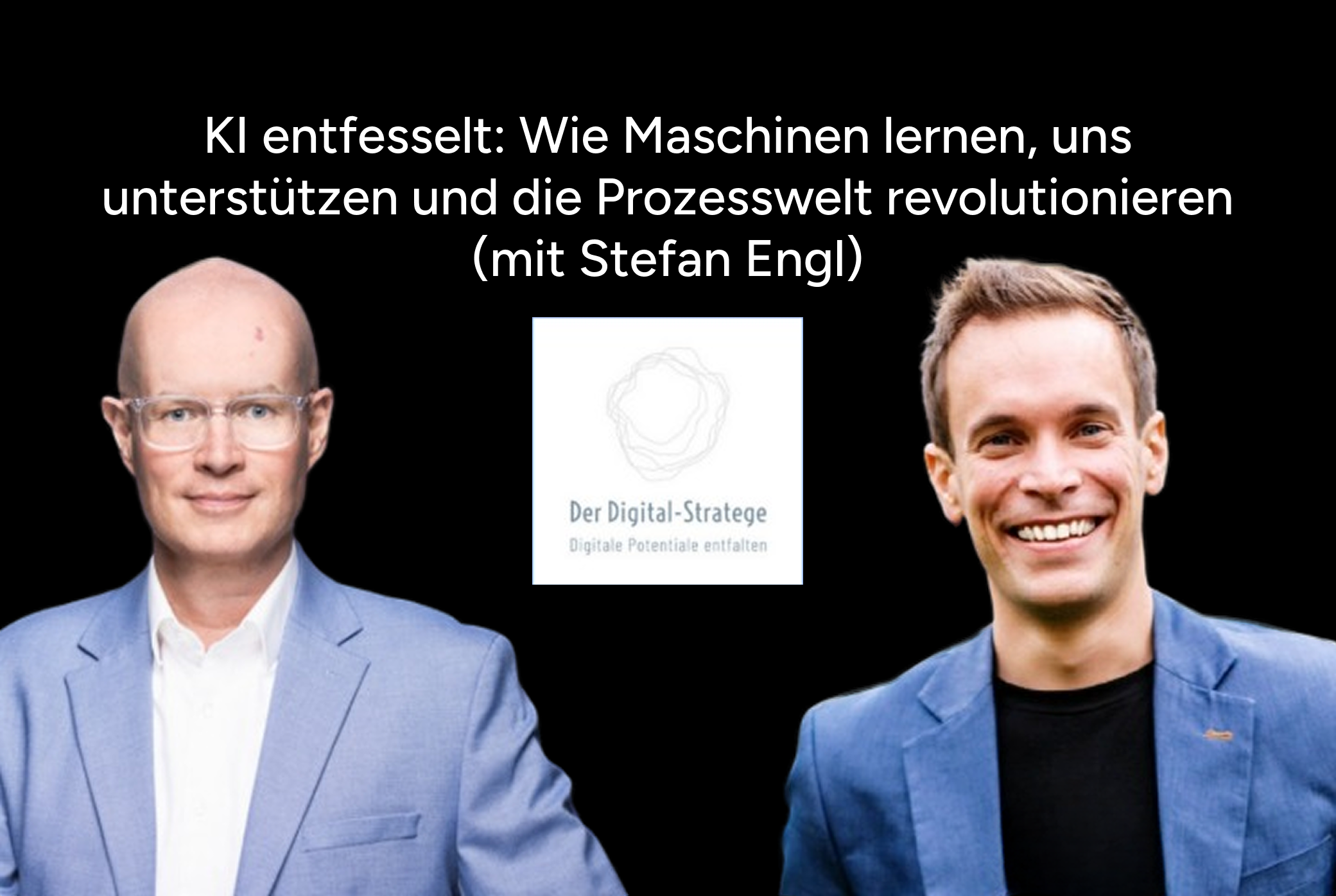
How the Baby Boomer Retirement Wave Demands a New Operating Model with Otera CEO Stefan Engl on Der Digital-Stratege
Stefan Engl, CEO of Otera, argues that autonomous agents are the only viable response to institutional knowledge walking out the door faster than hiring can replace it.
Across Europe, an entire generation of experienced operators is heading into retirement, and the institutional knowledge they carry is walking out the door with them. Hiring replacements at scale is not realistic. Neither is asking the remaining workforce to absorb the load. The organizations that sustain and grow operational capacity through this shift will be the ones that move beyond traditional automation toward truly autonomous operations, where specialized AI agents handle end-to-end processes and humans focus on governance and decisions that require judgment.
That was the central argument Stefan Engl, CEO and Co-Founder of Otera (previously DeepOpinion), brought to a recent episode of the Der Digital-Stratege podcast, hosted by Mario Eckmaier. The conversation explored why the workforce gap cannot be closed with conventional tools and what a fundamentally different operating model looks like in practice.
"We want to free people from the repetitive, boring, recurring tasks and actually bring them up a level to the tasks where there is real value, where there are really decisions to be made. Every person has these abilities inherently and is actually a bit wasted in these recurring tasks." says Stefan Engl, CEO and Co-Founder of Otera.
Key Takeaways from the Conversation
• The workforce gap is structural, not cyclical.
Engl outlined why the retirement of the baby boomer generation creates an operational capacity problem that hiring alone cannot solve. Organizations need to rethink how work gets done, not just who does it.
• Automation that still depends on humans for every exception is not enough.
The discussion examined how traditional automation digitizes fragments of a process but still leaves humans to reconcile edge cases, stitch outputs, and chase exceptions. The process stays fundamentally manual.
• Autonomous operations change the equation.
Engl described a model in which specialized AI agents execute complex processes end-to-end, while humans set the rules and intervene only when genuine judgment is required. A real-world case study of delivery note processing illustrated how this works in production.
"I hope I was able to offer a few nebula words and you can all go out with more sight than you came in." - Stefan Engl, CEO and Co-Founder of Otera
About Otera
Otera brings autonomy to the operations the world depends on. We transform mission-critical processes into governed AI systems that decide and act end-to-end, freeing enterprises to grow without limits. Trusted by Allianz, Siemens, Bayer, SAAB, and Hannover Re.
Otera (Previously DeepOpinion) Featured in Forrester’s New Report: “The AI Agent Pivot: A New Era for Process Design”
Forrester names Otera in its latest research on the future of enterprise process design. Here is why that matters.
The title alone signals where the analyst community sees enterprise operations heading. Forrester's latest report, "The AI Agent Pivot: A New Era for Process Design", features Otera (previously DeepOpinion) among the platforms shaping this emerging landscape. For anyone tracking the shift from manual operations to autonomous operations, the inclusion is worth noting.
Otera's view of this shift is straightforward. Most enterprise processes were designed for human execution, with software layered on top to assist. That architecture breaks down when the goal is not incremental efficiency but a fundamentally different operating model, one where specialized AI agents own the work end-to-end and humans govern by exception. Being recognized in a Forrester report focused on agent-driven process design suggests that this perspective is gaining traction beyond the companies already running it in production.
"The question facing every enterprise leader is no longer whether agents will run operations. It is whether your processes are designed to let them," said Stefan Engl, CEO of Otera. "Most organizations are still automating workflows that were built for people. The real unlock is redesigning operations so that agents can own them end-to-end, with humans setting the rules and intervening only where true judgment is required."
This is the principle Otera's platform is built around. Rather than layering AI onto legacy workflows, it enables enterprises to design processes where specialized agents collaborate across complex, exception-heavy operations, from intake through resolution, under full governance and auditability. The result is an operating model where volume and complexity scale without proportional growth in headcount, reshaping the cost structure of core operations worth up to hundreds of millions.
Across insurance, banking, and the public sector, the ability to transition from human-executed operations to autonomous operations is increasingly shaping competitive positioning. With clients including Allianz, Siemens, Hannover Re, and e&, Otera is where this transition is already running in production.
Click here to read the Forrester Report "The AI Agent Pivot: A New Era For Process Design"
About Otera
Otera brings autonomy to the operations the world depends on. We transform mission-critical processes into governed AI systems that decide and act end-to-end, freeing enterprises to grow without limits. Trusted by Allianz, Siemens, Bayer, SAAB, and Hannover Re.
“Autonomous”: Otera Q2 2025 Product Launch Event Recap
How CED, a major claims management company, went from growing backlogs on 600,000 annual emails to same-day processing with nearly zero errors.
Otera (previously DeepOpinion), the autonomous operations platform built for complex enterprise processes, today shared highlights from its Q2 2025 "Autonomous" product launch. The release introduces three platform capabilities designed to close the gap between automation and true operational autonomy, where specialized AI agents execute end-to-end processes while humans set the rules and govern outcomes.
This is a shift that enterprise operations leaders have been working toward for years. Not faster automation, but fundamentally different operations. One where the work itself runs autonomously, and human attention is reserved for the decisions that genuinely require it.
The results are already visible in production. CED, a claims management company processing hundreds of thousands of customer interactions per year, deployed Otera and moved from persistent backlogs to same-day resolution with near-zero error rates.
Autonomy, Control, and Velocity. The Foundations of Autonomous Operations
Otera's platform is built around three principles that define how enterprises transition from manual operations to autonomous ones.
• Autonomy means maximizing the share of tasks that complete with no human touch. Not partial automation of fragments, but end-to-end execution by agents across the full process.
• Control means embedding business rules and human oversight precisely where autonomy is not yet appropriate. The goal is governed autonomy, not unchecked automation.
• Velocity means time-to-value measured in weeks, not quarters. Enterprises running on Otera reach production within 12 weeks of deployment.
These are not aspirational targets. They describe how Otera's platform operates in production today for enterprises including CED, processing high-volume, exception-heavy workflows at scale.
Three Platform Capabilities That Advance Autonomous Operations
The Q2 2025 release introduces three major platform capabilities, each designed to move enterprises closer to fully autonomous operations.
1. New Agentic Flow Builder
A complete overhaul of Otera's no-code workflow builder. Teams can now design autonomous workflows visually, with real-time collaboration, reusable templates, Python scripting support, advanced error handling, and connectivity to over 400 enterprise systems.
The significance for enterprise operations is direct. Business teams build and own their autonomous workflows without dependency on IT or specialized engineering resources. Partial workflows can be tested independently and reused across departments, cutting the time from design to production.
2. AIO v2 (AI Optimization Engine)
The upgraded AI Optimization engine generates improved workflow instructions with a single click, moving workflows closer to full autonomy by allowing agents to self-optimize their decision logic.
For operations leaders, this means fewer human reviews, faster throughput, and a continuous narrowing of the exception pool that requires manual attention.
3. Control Hub Expansion
A major enhancement to Otera's governance layer, giving operations teams the ability to define complex business rules, build custom human validation interfaces, and dynamically route tasks, all without code.
This is where the "humans govern" principle becomes concrete. Operations leaders define which decisions require human judgment. High-value claims that need senior review, specific document types that route to specialist teams, or exception categories that trigger escalation. The platform enforces these rules autonomously.
"These updates aren't about making things easier for developers," commented Julien Palier, Otera's product lead. "They're about giving business teams direct control over where autonomy applies and where human oversight is required."
CED Achieves Same-Day Processing Across 600,000 Annual Interactions
The most concrete evidence of what autonomous operations deliver in production comes from CED, a claims management company that processes hundreds of thousands of customer interactions annually.
Before Otera, CED faced a growing backlog across its email-driven claims operations. The volume was unmanageable with existing headcount, and the complexity of the work made simple automation insufficient.
After deploying Otera, CED eliminated the backlog entirely. All processing now happens same-day with near-zero error rates, and the company achieved this without hiring additional staff.
"We went from 600,000 annual emails with growing backlogs... to processing everything same-day, with nearly zero errors," said Francois Goffinet, CEO of CED.
What stood out in CED's experience was that the value extended beyond technology deployment. Otera's analysts worked with CED's team to restructure operational logic that the organization's own teams had not been able to formalize on their own.
"The real value wasn't just in the technology," Goffinet explained. "It was in being able to structure some of our business realities that our own people hadn't been able to structure as well."
CED has since expanded its use of Otera across additional operational areas, with further use cases in deployment. The partnership has become a core part of how the company scales.
What Comes Next for Otera's Autonomous Operations Platform
The Otera team also shared several focus areas for upcoming releases, each designed to deepen the platform's autonomous capabilities.
• Agent teams that coordinate across multi-step, multi-party processes, enabling end-to-end autonomous execution of workflows that span departments and systems.
• Autonomy tracking that gives operations leaders real-time visibility into how much of a given workflow runs autonomously versus requiring human intervention.
• Reusable automation components that allow teams to scale proven autonomous workflows rapidly across business units and geographies.
• A customer certification program to help enterprise teams build internal expertise in designing and governing autonomous operations.
"We're building the infrastructure for a different operating model," said Kerem Sozugecer, VP of Product & Engineering at Otera. "One where enterprises can run complex operations autonomously, at scale, while maintaining full governance and control over every decision."
About Otera
Otera brings autonomy to the operations the world depends on. We transform mission-critical processes into governed AI systems that decide and act end-to-end, freeing enterprises to grow without limits. Trusted by Allianz, Siemens, Bayer, SAAB, and Hannover Re.

Autonomous Operations: The New Standard for Enterprise Operations
Legacy tools follow rules. Autonomous agents run the operation.
The automation era produced tools that assist humans. The autonomy era replaces the work entirely. Enterprises that will define the next decade are not optimizing their operations with better workflow tools; they are going live with autonomous agents that execute complex processes end-to-end, with humans governing by exception.
This is the distinction that separates incremental efficiency gains from operating model transformation. The old model: humans doing the work, tools assisting at the margins. The new model: agents doing the work, humans setting the rules. Every enterprise still running the old model is carrying a cost structure, a speed constraint, and a risk profile that autonomous operations eliminate.
Analyst firms are converging on this shift. Otera (previously DeepOpinion) was included in the IDC Market Glance: Agentic AI Applications, Tools, and Technologies, 2Q25 (doc #US53565925, June 2025), recognized among the vendors defining this fast evolving space..
From Automation to Autonomy: A New Model
RPA and workflow engines were built for structured, repetitive tasks. They break when they encounter ambiguity, unstructured data, or processes that demand judgment: underwriting, claims adjudication, customer onboarding, trade finance. These are the processes where the most operational cost concentrates, and where legacy automation delivers the least.
Autonomous operations replace this model at the root. Otera goes live with specialized decision agents that reason through complexity, make decisions within governed parameters, and execute entire processes from intake to resolution. Humans do not touch routine work. They intervene only when true judgment is required, governing outcomes rather than performing tasks.
The result is not a faster version of what enterprises already run. It is a different operating model entirely: one where core operations execute continuously, autonomously, and at a fraction of the legacy cost structure.
What Makes Autonomous Operations Different
Otera delivers autonomous operations across the most complex, exception-heavy processes in regulated industries. Three capabilities define the model:
Autonomy at scale. Specialized agents execute end-to-end, from document intake through decision-making to final resolution, processing millions of cases across enterprises like Allianz, Siemens, and Hannover Re.
Governance by design. Every agent decision carries confidence scoring, full auditability, and configurable exception routing. Compliance and human oversight are structural to the operating model, not bolted on after deployment. This is what makes autonomous operations viable in banking, insurance, and government, where regulatory scrutiny is constant.
Velocity to production. Enterprises go live in 6-12 weeks with zero customer training data required, eliminating the 12-to-18-month implementation cycles that have defined enterprise automation programs for decades.
Enterprise customers already running on Otera report 90%+ reductions in operational cost across core business processes, replacing cost structures that previously required hundreds of operators to sustain.
From Process Optimization to Autonomous Execution
The shift from automation to autonomy is not incremental. It is structural. Enterprises that make this shift do not get a marginally improved version of their current operations. They gain an entirely new capacity: the ability to handle ten times the volume without ten times the headcount, to enter new markets without building new operations teams, and to convert operational cost into competitive advantage worth hundreds of millions.
The IDC Market Glance confirms what is already running in production at some of the world's largest enterprises. The question for every C-level leader in insurance, banking, and government is no longer whether autonomous operations will replace legacy automation. It is whether their organization will lead the shift or follow it.

Otera highlighted in Forrester Report "Agentic AI Agents Are A Rare Sighting"
Why production-ready Autonomous Operations remain rare, and what it means for enterprise leaders.
From Otera's vantage point, serving enterprises like Allianz Partners and CED, the gap between what the market promises on autonomous AI and what actually runs in production remains significant. Many platforms market agentic capabilities, but in our experience, few deliver agents that execute complex, end-to-end enterprise processes at scale.
In April 2025, Forrester published a report titled "Agentic AI Agents Are A Rare Sighting." Otera (previously DeepOpinion) was named in the report. The full research is available directly through Forrester.
"The market conversation has moved past whether autonomous operations are possible. Enterprises like Allianz Partners and CED are already running them. The real question now is how quickly the rest of the market will follow," said Stefan Engl, CEO of Otera.
The operational impact at these enterprises has been substantial. Based on Otera's deployment data, organizations running autonomous operations through our platform report 60 to 80 percent reductions in operational costs, not through incremental process tuning, but by replacing the manual operating model entirely. When agents handle the full process lifecycle under governed parameters, the economics shift from linear headcount scaling to a fundamentally different cost structure.
François Goffinet, CEO of CED, a third-party administrator managing over 600,000 claims per year, described the change directly. "We achieved speed. We achieved zero backlog. Everything is done for the next day, and the feedback internally and externally has been very good."
Goffinet also pointed to the strategic ambition behind CED's shift toward autonomous operations. "What we are aiming for is the smile of the end customer. That's the ultimate metric we are after." With claim classification and routing running autonomously, CED's teams now focus exclusively on cases that demand human empathy and specialized judgment.
Otera's platform operates across 400+ enterprise systems, executing end-to-end processes under full enterprise governance across regions and product lines.
At Otera, we see a pattern that is becoming difficult to ignore. Autonomous operations are no longer a theoretical destination. They are running in production at global enterprises today. The question for operational leaders is no longer whether this shift will happen, but whether their organization will lead it or respond to it.
To read the Forrester report "Agentic AI Agents Are A Rare Sighting", click here.
About Otera
Otera brings autonomy to the operations the world depends on. We transform mission-critical processes into governed AI systems that decide and act end-to-end, freeing enterprises to grow without limits. Trusted by Allianz Partners, Siemens, Bayer, and SAAB.

From 600,000 Emails to Zero Backlog. How CED's Claims Operation Became Autonomous with Otera
CEO Francois Goffinet explains why the question was never how to make email triage faster, but how to remove it from the equation entirely, and what autonomous operations made possible when that question changed.
When a 2,500-person claims operation processes every inbound email same-day with zero backlog and near-zero errors, that is not a process improvement. It is a fundamentally different operating model. Francois Goffinet, CEO of CED, explains what changed when his organization shifted from manual email triage to autonomous claims processing with Otera (previously DeepOpinion).
The Challenge. Scaling a Claims Operation Without Scaling the Administrative Burden
CED manages claims across the full lifecycle for insurance clients, with roughly 2,500 people active across the value chain. Growth created a familiar tension at enterprise scale. More volume demanded more capacity, but CED's real differentiator was never processing speed. It was the quality of interaction between its teams and the policyholders they serve.
"What we are aiming for is the smile of the end customer," says Goffinet. "That's the ultimate metric we are after."
The administrative weight of triaging, sorting, and routing hundreds of thousands of inbound emails per year was absorbing the time and focus CED's people needed for those higher-value customer interactions. The question was not how to make that work faster. It was how to remove it from the equation entirely so the organization could redeploy capacity toward what actually differentiates CED in the market.
Why CED Chose Otera. Bridging Technology and Operational Reality
CED selected Otera for a specific reason that went beyond technical capability. "What was really a differentiated component is the ability to make the bridge between the technology and our business reality," Goffinet explains. Otera's team invested significant time upfront to understand and formalize CED's operational processes, in some cases structuring patterns and decision logic that CED's own teams had not codified.
That calibration phase was critical because the goal was not to automate one task within an otherwise manual workflow. It was to redesign how an entire operational process runs, with specialized agents handling volume autonomously while humans focused on judgment, exceptions, and customer relationships.
The Results. Same-Day Processing, Zero Backlog, Near-Zero Errors
CED receives 600,000 emails per year, many with attached documents that require classification and routing into the correct workflows. Today, email qualification runs autonomously. Every item is processed same-day. Backlog has been eliminated entirely. Error rates are near zero.
For an operation at this scale, the downstream impact is significant. Same-day, near-error-free processing directly improves the experience of every policyholder CED serves, which strengthens CED's value proposition to its insurance clients. When administrative burden disappears, the organization can invest its capacity where it compounds.
"Feedback internally and externally has been very good," Goffinet confirms. "I would like to expand the scope of what we do together and continue to roll out these solutions in our organization."
That expansion signals something worth noting. When an enterprise with 2,500 people and 600,000 annual inbound communications moves to extend autonomous operations further into its value chain, it is not optimizing at the margins. It is adopting a new operating model.
About Otera
Otera brings autonomy to the operations the world depends on. We transform mission-critical processes into governed AI systems that decide and act end-to-end, freeing enterprises to grow without limits. Trusted by Allianz, Siemens, Bayer, SAAB, and Hannover Re.

Otera Named to UAE Future100 List as Autonomous Operations Reshape Enterprise Technology
The UAE Future100, published by the UAE Ministry of Economy, has named Otera among 100 companies shaping the country's economic future.
The enterprises and governments that will define the next decade are not optimizing their existing operations. They are replacing them. The UAE Future100 list for 2024, published by the UAE Ministry of Economy and the Government Development and the Future Office, has named Otera (previously DeepOpinion) among 100 companies shaping the country's future economic landscape. For leaders evaluating how their organizations will operate in five years, this selection points to a broader market shift away from legacy automation and toward fully autonomous enterprise operations.
The Future100 evaluates startups and scaleups on innovation, market potential, business scalability, and ESG impact. Otera's inclusion signals growing institutional confidence in a new operating model, one in which specialized AI agents execute complex, end-to-end business processes autonomously while humans focus on governance and exception handling.
"The operating model that defined the last two decades of enterprise technology is reaching its limits," said Stefan Engl, CEO of Otera. "Organizations across the region and globally are recognizing that they don't need better tools to assist their teams. They need operations that run autonomously, with human oversight applied where true judgment is required. The Future100 validates that this shift is well underway in one of the world's most forward-looking economies."
This shift is already visible in production. Where legacy automation reduced claims timelines from weeks to days, Otera's autonomous agents have compressed the cycle from weeks to minutes, fundamentally changing the economics of operations-heavy industries such as insurance and financial services.
François Goffinet, CEO of CED, described the operational impact of working with Otera. "We were receiving 600,000 emails per year with many documents. We process everything same-day with zero backlog, and error rates are close to zero. For us, the key is to provide our clients' clients the best possible customer experience."
CED's experience reflects a pattern across Otera's enterprise deployments. Operations that previously required large teams working through multi-day backlogs now resolve autonomously within hours. The platform does not accelerate existing workflows. It replaces them with autonomous processes in which agents manage intake, decision-making, and resolution without human intervention on routine work.
The UAE has positioned itself as a proving ground for this kind of operational transformation, and the Future100 program is one lens through which the government identifies the companies delivering it. As more enterprises in regulated industries move from pilot programs to production-scale autonomous operations, the gap between organizations that made this shift early and those still relying on legacy models will become increasingly difficult to close.
About Otera
Otera brings autonomy to the operations the world depends on. We transform mission-critical processes into governed AI systems that decide and act end-to-end, freeing enterprises to grow without limits. Trusted by e&, Allianz, Siemens, Bayer and SAAB.

The Scattered Spider Threat: Why EU Insurance Companies Might Be Next and How Many Popular SaaS Integrations Enable Modern Attacks
The Scattered Spider cybercriminal collective has systematically targeted US insurance companies, and Otera's security team assesses the campaign will expand to EU BFSI sectors.
Disclaimer: The following demonstration is intended solely for educational and authorized security research in controlled environments. It should not be replicated in production systems or used without proper authorization.
A Growing Alarm in the Threat Landscape
At Otera (previously DeepOpinion), our security, compliance and engineering teams maintain constant vigilance over the evolving threat landscape, monitoring emerging attack patterns that could impact both our organization and our customers. Recently, we’ve observed a concerning trend that has escalated our threat assessment: the cybercriminal collective known as Scattered Spider has begun systematically targeting insurance companies across the United States.
This shift represents more than just another sector being attacked, it signals a strategic evolution in one of the most sophisticated and successful threat actors of the modern era. Based on historical patterns, we anticipate this campaign will likely expand to insurance and broader Banking, Financial Services, and Insurance (BFSI) sectors across the European Union in the coming months.
What makes this particularly alarming is not just who Scattered Spider targets, but how they operate. This isn’t a traditional cybercriminal organization with hierarchical command structures. Instead, Scattered Spider represents something more dangerous: a distributed methodology that combines masterful social engineering with an intimate understanding of the modern SaaS ecosystem that unlike Otera often offers unsolicited apps to be added to it’s market place and integrations and increasingly forms the backbone of enterprise operations.

Understanding Scattered Spider: A Methodology, Not Just a Group
To understand the threat Scattered Spider poses, we must first recognize what they truly are. Despite the singular name, Scattered Spider is better understood as a loose collective of individuals, primarily young, English-speaking attackers from the US, UK, Canada, and Australia, many in their teens to early twenties. They operate more like a shared playbook than a traditional criminal organization.
This distributed nature is precisely what makes them so resilient. When law enforcement arrested several key members in 2024, including alleged leader Tyler Buchanan in Spain and others across multiple jurisdictions, the attacks didn’t stop. New individuals simply adopted the proven methodologies, continuing operations with barely a pause. The group’s techniques have become so effective that they’ve essentially created a replicable attack framework that others can implement.
Their track record speaks to this effectiveness:
• MGM Resorts (September 2023): A 36-hour system outage resulting in over $100M in losses and 6TB of stolen data
• Caesars Entertainment (August 2023): $15M ransom payment after customer database compromise
• Transport for London (September 2024): 5,000 users’ bank details exposed, 30,000 staff requiring password resets
• UK Retail Campaign (2025): Marks & Spencer alone suffered £300M in lost profits and £1B in share value impact
The Perfect Storm: Modern SaaS Ecosystems as Attack Vectors
What makes Scattered Spider particularly dangerous in today's enterprise environment is their deep understanding of how modern businesses operate. Organizations increasingly rely on complex webs of Software-as-a-Service (SaaS) applications, many of which, unlike Otera—have internal marketplaces and integrations that allow for unsolicited additions, each connected through identity and access federation systems that provide seamless access to vast amounts of data.
This interconnected ecosystem, while enabling unprecedented productivity and collaboration, has created new attack surfaces that traditional security measures struggle to address. OAuth integrations, API access tokens, and third-party application marketplaces have become the new frontier for sophisticated attackers.
To demonstrate just how realistic and widespread this threat is, our security team developed a proof-of-concept that simulates a Scattered Spider-style attack targeting SaaS integrations. While our demo uses Notion as an example, the attack methodology applies to virtually any SaaS platform with an integration marketplace, Slack, Microsoft 365, Google Workspace, Salesforce, and countless others.
Anatomy of a Modern SaaS Attack: A Realistic Demonstration
To illustrate the severity and accessibility of this threat, our security team developed a fully functional proof-of-concept that demonstrates how easily these attacks can be executed. The complete source code for our demonstration is available on GitHub, with strict disclaimers that it should only be used for educational purposes in controlled environments with explicit authorization.
What makes this attack particularly concerning is how simple it is to set up. The screenshot below shows Notion's integration creation interface, where anyone can register a new application with extensive permissions. This process takes mere minutes and requires no verification of the developer's identity or intentions:

The ease of creating legitimate OAuth applications with extensive permissions demonstrates a fundamental vulnerability in the SaaS ecosystem. Once an application is registered, it can be used globally to target any Notion workspace, making the attack scalable across thousands of potential victims.
Our proof-of-concept demonstrates a four-stage attack that mirrors real-world Scattered Spider tactics:
Stage 1: The Phishing Hook
The attack begins with a carefully crafted email that exploits common business pain points. In our demo, the attacker poses as “McAccelerate,” offering enterprise Notion features at startup prices a compelling proposition for cost-conscious organizations.
The email demonstrates sophisticated social engineering:
• Personalization: References the target company’s industry and growth
• Pain Point Exploitation: Addresses real concerns about enterprise software costs
• Urgency Creation: Limited-time offers and scarcity tactics
• Professional Presentation: Legitimate-looking branding and messaging
Stage 2: The Convincing Landing Page
Victims are directed to a professional-looking application page that appears to be a legitimate SaaS tool. The page includes:
• Trust indicators (customer counts, compliance badges)
• Feature lists that address real business needs
• Professional design that mirrors legitimate SaaS applications
• A prominent “Connect with Notion” OAuth button
Stage 3: Legitimate OAuth Authorization
Here’s where the attack becomes particularly insidious. When users click the connection button, they’re redirected to Notion’s actual OAuth consent screen not a fake page, but the real authorization flow. The malicious application requests seemingly reasonable permissions to deliver on it’s promises:
• Read all pages and databases
• Create and edit pages
• Access shared workspaces
• Read user information
To most users, these permissions appear necessary for the promised functionality. The OAuth flow is legitimate, the permissions seem reasonable, and the consent screen is from the trusted SaaS provider.
Stage 4: Data Exfiltration Through Legitimate APIs
Once authorized, the malicious application gains full API access to the organization’s Notion workspace with the user’s exact scope. Our demonstration shows the extraction of:
• User Data: Complete employee directory with names, roles, and contact information
• Workspace Content: All pages, documents, and collaborative content
• Database Information: Structured data including customer information, project details, and business intelligence
• Comments and Discussions: Private conversations and internal communications
The critical point is that all of this data access occurs through legitimate API calls. From a security monitoring perspective, these requests appear completely normal because they are normal API usage, just by an unauthorized party.
Why This Attack Circumvents Traditional Security Measures
This attack methodology is particularly effective because it bypasses multiple layers of traditional security controls:
Multi-Factor Authentication (MFA) Bypass
OAuth flows often bypass MFA requirements because the user has already authenticated with the SaaS provider. Once the application is authorized, it can access data using API tokens without requiring additional authentication.
Detection Evasion
Security teams monitoring for suspicious activity will see legitimate API calls from an authorized application. There are no failed login attempts, no unusual access patterns, and no technical indicators of compromise just normal API usage.
User Trust Exploitation
Users are conditioned to trust OAuth flows from legitimate SaaS providers. When they see Notion’s actual consent screen, they assume the application must be legitimate because it’s using official authorization mechanisms.
The Integration Marketplace Problem
A critical vulnerability in the modern SaaS ecosystem is the open nature of integration marketplaces. Most major SaaS platforms allow anyone to create and publish integrations, creating numerous opportunities for malicious actors:
Typosquatting and Name Collision
Attackers can create applications with names similar to legitimate tools:
• “NotionBoost” instead of “Notion Boost”
• “SlackEnhancer” instead of “Slack Enhancer”
• “TeamsOptimizer” instead of “Teams Optimizer”
Fake Sales and Marketing Campaigns
Sophisticated attackers create entire marketing campaigns around their malicious applications, including:
• Professional websites and documentation
• Social media presence and testimonials
• Email marketing campaigns targeting specific industries
• Conference presentations and thought leadership content
IT Impersonation
Attackers may impersonate internal IT teams, requesting employees install “necessary” integrations for compliance, security, or productivity purposes. Given the constant introduction of new tools in modern workplaces, employees rarely question such requests.
Why Insurance Companies Are Prime Targets
Scattered Spider’s focus on insurance companies is strategically sound from an attacker’s perspective:
High-Value Data Assets
Insurance companies possess some of the most valuable data for cybercriminals:
• Complete customer profiles including financial information
• Claims data revealing personal circumstances and vulnerabilities
• Underwriting information containing detailed risk assessments
• Business relationships and partnership details
Complex SaaS Ecosystems
Modern insurance operations rely heavily on interconnected SaaS applications:
• Customer relationship management systems
• Claims processing platforms
• Document management and collaboration tools
• Communication and video conferencing solutions
• Analytics and business intelligence platforms
Help Desk Vulnerabilities
Insurance companies often have large customer service operations with help desk systems, exactly the type of infrastructure Scattered Spider excels at compromising through social engineering.
Regulatory Compliance Pressure
The heavily regulated nature of the insurance industry creates urgency around compliance and security tools, making employees more likely to quickly approve integrations that claim to address regulatory requirements.
The European Expansion: A Predictable Pattern
Based on Scattered Spider’s historical attack patterns, we anticipate their insurance sector campaign will expand to European markets. Several factors support this prediction:
Historical Precedent
Scattered Spider has consistently followed a pattern of successful US attacks followed by international expansion:
• Casino attacks began in the US, then expanded globally
• Retail campaigns started in the UK, then spread to other markets
• The group’s English-speaking nature facilitates expansion to English-speaking markets and international businesses
GDPR Amplification
The European Union’s General Data Protection Regulation (GDPR) creates additional extortion opportunities. Data breaches involving EU citizens carry significant financial penalties, giving attackers additional leverage for ransom demands.
Similar SaaS Adoption Patterns
European BFSI organizations have adopted SaaS solutions at similar rates to their US counterparts, creating comparable attack surfaces and vulnerabilities.
Defense Strategies: Building Resilience Against SaaS-Based Attacks
Organizations must adapt their security strategies to address the realities of SaaS-based attacks:
OAuth Application Review Processes
Implement formal review processes for all third-party integrations:
• Require security team approval for new OAuth applications
• Maintain an inventory of all authorized integrations
• Regularly audit and remove unused applications
• Establish criteria for evaluating integration security
API Access Monitoring and Anomaly Detection
Deploy monitoring solutions that can identify suspicious API usage patterns:
• Unusual data access volumes or patterns
• Access to sensitive data by recently authorized applications
• API calls from unexpected geographic locations
• Bulk data extraction activities
Enhanced Employee Training
Security awareness training must evolve to address SaaS-specific threats:
• Recognition of sophisticated phishing campaigns
• Understanding of OAuth risks and proper authorization procedures
• Identification of social engineering tactics targeting SaaS integrations
• Proper escalation procedures for suspicious integration requests
Principle of Least Privilege for Integrations
Apply zero-trust principles to SaaS integrations:
• Grant minimum necessary permissions to third-party applications
• Implement time-limited access tokens where possible
• Regularly review and reduce application permissions
• Segregate sensitive data from general SaaS platforms
Help Desk Security Protocols
Strengthen help desk operations against social engineering:
• Implement multi-factor verification for sensitive requests
• Use out-of-band verification methods for identity confirmation
• Train staff to recognize and escalate suspicious requests
• Maintain detailed logs of all help desk interactions
Otera’s Commitment to Proactive Security
At Otera, we believe that understanding and preparing for emerging threats is essential for protecting both our organization and our customers. Our development of this proof-of-concept demonstrates our commitment to:
Continuous Threat Monitoring
Our security team actively monitors the evolving threat landscape, identifying emerging attack patterns and techniques that could impact our industry and customers.
Practical Security Research
We don’t just read about threats we build practical demonstrations that help us understand attack methodologies and develop effective countermeasures.
Knowledge Sharing
By sharing our research and insights, we contribute to the broader security community’s understanding of emerging threats and defense strategies.
Customer Protection
Our proactive approach to threat research directly benefits our customers by ensuring our security measures evolve ahead of the threat landscape.
Looking Forward: The Evolution of SaaS Security
The Scattered Spider threat represents a fundamental shift in how we must think about enterprise security. Traditional perimeter-based security models are insufficient when the “perimeter” includes dozens or hundreds of SaaS applications, each with their own integration ecosystems.
Organizations must evolve their security strategies to address:
• The reality of distributed, cloud-native operations
• The complexity of modern identity and access management
• The human element in sophisticated social engineering attacks
• The need for continuous monitoring and adaptation
As Scattered Spider and similar threat actors continue to evolve their techniques, we will continue to research, analyze, and share our findings. The threat landscape is constantly changing, but through proactive research, practical demonstrations, and collaborative defense strategies, we can stay ahead of even the most sophisticated attackers.
The insurance industry’s current targeting by Scattered Spider serves as a wake-up call for all organizations operating in the modern SaaS ecosystem. By understanding these threats and implementing comprehensive defense strategies, we can protect our data, our customers, and our operations from even the most sophisticated attack methodologies.
The Otera Security Team continues to monitor the Scattered Spider threat and will provide updates as new intelligence becomes available. For questions about this research or to discuss security strategies for your organization, contact our security team via security@otera.ai
Disclaimer: The proof-of-concept described in this post was developed for educational and security research purposes only. It was tested only in controlled environments with explicit authorization and should not be replicated without proper authorization and ethical considerations.

SEF Podcast: Why the Shift from Automation to Autonomous Operations Changes Everything
Ahmed Al-Ali, makes the case for why the shift to autonomous operations is now the defining competitive question for enterprise leadership.
The Enterprises Pulling Ahead Aren't Automating. They're Replacing the Operating Model Entirely.
The Real Drag on Enterprise Performance Isn't Inefficiency. It's the Model Itself.
The problem isn't that repetitive work is slow. The problem is that the operating model still depends on humans to execute, reconcile, and stitch together processes that should run on their own. Most organizations have spent the last decade layering tools on top of fundamentally manual operations. The tools got better. The operating model didn't change.
That distinction now separates the enterprises gaining ground from those falling behind. In a recent SEF Backstage Pass Podcast, Otera (previously DeepOpinion) co-founding partner Ahmed Al-Ali made the case for why the transition from task-level automation to fully autonomous operations is now the defining competitive question for enterprise leadership.
Why General-Purpose AI Makes Autonomous Operations Inevitable
The market has not simply added a new tool. It has gained a general-purpose technology with the same structural impact as electricity or the internet.
"AI, and more specifically, generative AI, is a general purpose technology," Ahmed explained. "That means it's a foundational technology that allows innovation to be built on top of it, and accordingly create a more positive impact on the abundance of resources."
The implication for enterprise leaders is not incremental. When a technology becomes general-purpose, it doesn't just improve existing workflows. It makes entirely new operating models viable. For the first time, AI agents can execute complex, multi-step business processes end-to-end, with humans setting the rules and intervening only on true exceptions.
That is not a faster version of what existed before. It is a different model of how operations run.
• New cost structures where 60–80% of operational spend shifts from labor-intensive process execution to governed autonomous operations
• New organizational capacity where the same team handles multiples of their current volume without proportional headcount growth
• New customer experiences where resolution happens instantly because the entire process runs without human handoffs
From Offloading Tasks to Replacing the Way Operations Work
The conventional pitch for automation has always been about offloading repetitive tasks so employees can focus on higher-value work. That framing is outdated.
Ahmed described how Otera approaches this differently. "We are helping organizations to automate their repetitive process and help them to be more productive and achieve higher value for their operations. Employees do not enjoy doing repetitive tasks. They are actually looking for fulfilling work."
But the real strategic shift goes beyond employee experience. When AI agents execute processes end-to-end, the operating model itself changes. Teams no longer spend their time on execution and reconciliation. They govern. They handle the exceptions that genuinely require human judgment. And the organization gains capacity it could never achieve through incremental headcount or process optimization alone.

Where Autonomous Operations Are Already Running in Production
The organizations furthest ahead are not experimenting. They are deploying autonomous agents on the complex, exception-heavy processes that legacy automation could never handle.
For operations like procurement and inventory management, Ahmed described how agents now execute the full cycle. "AI actually can receive this document, review it, check that you actually bought this item, and then book it off in your ERP system, and hence, automate that process and keep track of your inventory." What makes this transformational is that the agent doesn't just process a document. It handles the judgment calls, the cross-referencing, and the system updates that previously required a human at every step.
The same logic applies to customer-facing operations. "Customers do not want to talk to your customer support," Ahmed noted. "In every single survey, it says that customers prefer a touchless and instant process, and the only way to do this is with AI." When the full resolution process runs autonomously from intake to outcome, the customer experience fundamentally changes. No queues. No handoffs. No waiting for a human to approve what an agent already resolved.
Organizations like Siemens and DEWA are applying this across high-stakes, multi-system workflows where the operational impact runs into the hundreds of millions.
• End-to-end claims and case management spanning intake, assessment, decision, and settlement across multiple systems and parties
• Autonomous ERP and back-office operations where agents execute cross-system updates, reconciliations, and exception handling without manual intervention
• Complex document-intensive processes with high variability, unstructured inputs, and regulatory requirements that demand both speed and auditability
{{subscribe}}
Why Most AI Initiatives Stall. And What the Successful Ones Do Differently.
The barrier to autonomous operations is not technical. It is organizational. Most enterprises are still structured around the assumption that humans execute and tools assist. Transitioning to a model where agents execute and humans govern requires rethinking roles, workflows, and decision rights.
Ahmed was direct about where the responsibility sits. "The challenge that we face today is mainly an organizational challenge. How can we leverage this technology? How do we manage change? How do we transition to that direction smoothly? And this is something that at least the C suite cannot outsource."
The organizations making this transition successfully share a common pattern. Leadership treats autonomous operations as an operating model decision, not a technology procurement. They invest in building their teams' understanding of where agents can take over end-to-end execution, and they redesign workflows around governed autonomy rather than layering AI on top of the old manual structure.
The Structural Threat That Small, Autonomous Teams Represent
Perhaps the most consequential implication of autonomous operations is what it means for competitive structures themselves.
"Will that job be with the same organization, or would we start to see the first one person or 10 people, billion organizations appearing in the next decade," Ahmed reflected, "because you know now you can augment yourself and be able to create innovative ideas and products without really needing crazy resources to make it happen."
For enterprise leaders, this is not a theoretical question. If a 10-person company backed by autonomous agents can deliver the operational throughput of a 2,000-person team, the competitive threat is existential. The response is not to automate faster within the old model. It is to adopt the new one before leaner competitors do it first.
What the Transition to Autonomous Operations Actually Requires
Phase 1: Assess Where Autonomy Creates Transformational Impact
• Identify the high-value, exception-heavy processes where manual execution is consuming the most organizational capacity
• Evaluate which operations could shift from human-executed to agent-executed with human governance
• Quantify the operating model impact in terms of capacity, speed to resolution, and customer experience, not just cost savings
Phase 2: Deploy Autonomous Operations on High-Impact Processes
• Prioritize deployment where the operating model shift creates enterprise-scale impact, not just departmental efficiency
• Build cross-functional teams that combine operational domain expertise with an understanding of how autonomous agents work
• Define governance frameworks that clarify when agents decide, when humans intervene, and how exceptions are escalated
Phase 3: Evolve the Organization Around Governed Autonomy
• Redesign team structures so that human effort concentrates on judgment, strategy, and the exceptions that require genuine expertise
• Develop new capabilities in process governance, agent oversight, and continuous optimization of autonomous workflows
• Build feedback loops that continuously expand the scope of what agents can handle end-to-end
The Competitive Line Has Moved. The Question Is Which Side You're On.
The divide is no longer between organizations that use AI and those that don't. It is between those still running manual operations with better tools and those whose operations run autonomously under human governance.
As Ahmed put it, this is not about replacing people. It is about building organizations where human energy goes toward the complex problems, the strategic decisions, and the customer relationships that actually create competitive advantage, while everything else runs on its own.
Otera (prev. DeepOpinion) Secures €11 Million Series A to Scale Autonomous Operations Across the Enterprise
Otera's €11 million Series A funds the acceleration of autonomous operations globally.

The enterprises pulling ahead in insurance, banking, and telecommunications are not optimizing their existing operations. They are replacing them entirely with autonomous processes, where specialized AI agents execute end-to-end work while humans govern exceptions and set the rules. Otera (previously DeepOpinion) has raised €11 million in a Series A funding round to accelerate this shift at global scale.
The round was co-led by Red River West and Alpha Intelligence Capital, with continued participation from Lunar Ventures and Stride VC. The investment will fund Otera's expansion into new markets and the continued evolution of its platform for autonomous enterprise operations.
From Devastation to Hope
Recent floods in Austria put a familiar failure mode on full display. Insurers faced a 10 to 50-fold surge in claims, and the traditional operating model buckled under the weight. Human administrators processing each claim individually meant resolution times stretched to roughly five weeks per case, compounding financial and psychological distress for victims already in crisis.
The underlying problem is structural, not procedural. The bulk of information flowing through insurance operations is unstructured. Emails, photos, invoices, handwritten forms, messages across channels. Legacy automation was never built to handle this complexity end-to-end. With 93 million people affected by natural disasters globally in 2023 alone, the gap between what traditional systems can handle and what the situation demands continues to widen.
Otera's platform represents a fundamentally different approach. Rather than assisting human operators with fragments of the process, autonomous agents take ownership of the full workflow, from intake and document comprehension through assessment and resolution. Human oversight applies where genuine judgment is required. The rest runs autonomously.
In disaster-response scenarios, this means claims that once consumed weeks of manual effort can now move through the entire process without human touch on the routine path. The operational impact is not incremental. For a large insurer processing hundreds of thousands of claims annually, the difference between weeks-long backlogs and same-day autonomous resolution represents a transformation measured in tens of millions of euros in operational savings and significantly faster relief for policyholders.

Pioneering the $850 Billion Revolution in Enterprise Automation
Otera's AI technology is poised to disrupt the $850 billion global back-office operations market. The company's advanced AI stack targets repetitive cognitive tasks across multiple industries, offering a versatile solution for complex business operations.
Otera's AI revolutionizes claims processing, document management, and underwriting in the insurance sector. It streamlines customer onboarding, trade financing, and loan processing for banking. The technology's reach extends to shared services, manufacturing, telecommunications, and well beyond.
Stefan Engl, Otera's co-founder, emphasizes the platform's transformative nature: "We're not just improving productivity; we're reinventing work itself. Our AI delivers full autonomy for knowledge-intensive workflows, automating entire processes end-to-end."
Engl highlights the multiple impacts of their solution: "We're addressing the evolving workforce dynamics by automating tasks unappealing to younger generations and filling gaps left by retiring workers. Simultaneously, we're meeting the 'instant expectation economy' demands through rapid, automated operations. This empowers businesses to expand seamlessly across sectors, driving growth and efficiency."
A Unique Approach to Solving Complex Knowledge Work
"Otera stands out in the crowded AI landscape with its ability to fully automate complex knowledge work at scale," said Antoine Blondeau, Managing Partner at Alpha Intelligence Capital.
Oliver Huez, Partner at Red River West added, "Traditional automation tools, like robotic process automation (RPA) systems, were never structured to fully automate end-to-end knowledge work. Unstructured data, such as documents, emails, and tickets, constitute the bulk of information flow in the business world. Without a solution to handle these, the level of automation is limited. We talked to many players, and none have come close to Otera in terms of performance. Otera’s technology and ability to handle such data provide its clients a higher return on investment, an order of magnitude higher, positioning it as a leader in the next wave of intelligent automation systems for business operations.”
Otera's proprietary technology leverages context-understanding capabilities and large language models (LLMs) to process any data you’d expect to encounter in a back office. It adapts to any document type, offering zero-shot document understanding that eliminates the need for templates or training data, and connects to over 200 enterprise software tools. The solution is ready-to-go, and organizations can streamline operations in weeks instead of several quarters.
Karsten Vogel, an Innovation Leader at Uelzener Insurance, and a user of Otera said: "The big challenge for us is dealing with highly unstructured data and very different invoices, and ensuring that they are all processed accurately. Before working with Otera, the technology wasn’t able to deliver the results we needed, and manual intervention was still required.
"Currently, we are extremely satisfied with our results [...] Otera stands out because of its technological solution and progress. The speed at which we can bring projects to market, within a quarter, is extraordinary. This is not something we could have achieved with other providers."
Otera has bolstered its leadership team with four automation industry veterans. Graeme Clark, former SVP - EMEA at Blue Prism, UiPath’s former Regional Vice President Chris Zechmeister, former Sales Director Enterprise Accounts Christiane Klecz, and former Director - Strategic Partnerships EMEA Hendrick Leitner. These executives bring deep expertise in scaling AI and automation companies. Their addition signals Otera's intent to accelerate its market presence and refine its AI-driven automation platform for enterprise applications.
Clients across the insurance, financial services, and telecommunications sectors have already turned to Otera. Notable names include manufacturer Siemens, telecom provider e&, trading platform BitPanda, reinsurer HannoverRE, and insurers such as Uelzener and Allianz, which have reported automating important claims processing tasks using Otera's platform.
Engl added, “With our technology, victims of everyday inefficiencies or even natural disasters won’t need to wait for support from their insurer, bank or otherwise. The space between a request and response will be near instant, and people will use the available time to invest in human relationships, paving the way for a future where efficiency and empathy coexist seamlessly.”
About Otera
Otera offers an enterprise-grade Agentic Automation platform enabling teams to put their business operations on autopilot - especially the hundreds of challenging unstructured data jobs like claims management, loan approvals, and purchase-to-pay processing. Combining Agentic AI, business process digitization, and no-code development, Otera enables teams to create sophisticated AI apps in minutes to achieve 90%+ straight-through processing efficiency. Trusted by industry leaders such as Allianz, HannoverRe, Erste Group, e&, Bitpanda, and Siemens, Otera's innovative solution allows insurers, banks, shared service centers, and more worldwide to realize unprecedented savings, speed, and scalability.
About Red River West
Red River West is a transatlantic VC fund supporting exceptional European technology companies with differentiated offerings for the US market. The fund is led by tech entrepreneurs and investors in Europe and the US, who all share a track record of building and backing start-ups that became global leaders through EU to US expansion. Red River West believes Europe is home to a talented and driven pool of entrepreneurs. By providing significant financial firepower and hands-on support in Europe & the US, Red River West helps these entrepreneurs realize their full potential. For more information, visit: www.redriverwest.com.
About Alpha Intelligence Capital
Alpha Intelligence Capital (AIC) is an entrepreneurs-led, entrepreneurs-invested global venture capital platform. It focuses on investing in companies developing advanced Artificial Intelligence and Machine Learning (AI/ML) technologies in the Seed to Series B stages, creating breakthrough products and solving real business problems. The teams at AIC operate out of San Francisco, Paris, and Singapore. For more information, visit www.aicapital.ai.

Securing the Agentic AI Revolution
Autonomous AI agents introduce a security challenge that is fundamentally new, enterprises must now protect not just infrastructure, but systems that act autonomously on their behalf.
Part I - A Dual Perspective on Enterprise Security
Enterprise security as we know it is unraveling and agentic AI is holding the thread. As organizations increasingly embrace AI systems that autonomously act on behalf of users, they face an unprecedented dual challenge: not only must they secure their traditional infrastructure and applications, but they must also adapt to an entirely new paradigm where AI agents have become both powerful security allies and critical new attack vectors.
The Agentic AI Revolution Is Here
We stand at the dawn of what industry leaders are calling "the agentic AI revolution." According to Anthropic's chief scientist Jared Kaplan, we're witnessing a paradigm shift where AI systems are moving beyond mere text generation to autonomously performing complex tasks with minimal human supervision. Sam Altman of OpenAI has boldly proclaimed that "in 2025, we may see the first AI agents 'join the workforce' and materially change the output of companies." This isn't idle speculation – it's already beginning.
At Otera (previously DeepOpinion), we've embraced this transformation, positioning ourselves at the forefront of agentic AI solutions enabling global enterprises, including Allianz, Siemens, HannoverRe, CED, e& and Bitpanda, to put mission-critical business operations on autopilot. The days of simply discussing "cognitive automation" are behind us. Today's AI agents can understand context, use tools, operate across environments, and execute complex workflows with unprecedented capabilities. As Gartner predicts, by 2028, 15% of day-to-day business decisions will be made completely autonomously by AI agents.
But this rapid acceleration brings significant security implications that traditional frameworks aren't equipped to address.

Emerging Security Challenges in the Agentic AI Landscape
The agentic AI revolution brings with it a set of security challenges that traditional cybersecurity frameworks simply weren't designed to address. At Otera, we've identified several critical vulnerabilities that organizations must prepare for:
1. Agent-to-Agent Privilege Escalation: As AI agents collaborate across organizational boundaries, we're seeing new attack vectors where compromised agents with limited permissions can exploit trust relationships to gain access to high-privilege agents, creating novel lateral movement risks in the enterprise.
2. Trusted Source Redirection Attacks: Perhaps most alarming are scenarios where agents with internet access visit seemingly trustworthy platforms (like Reddit, Twitter, or academic repositories) only to encounter posts containing links to malicious destinations. Picture this: a shopping assistant agent searching for a customer's requested product encounters a Reddit post that appears to offer relevant information, but contains a link to a malicious site. When the agent visits this site, embedded instructions convince it to fill out a form with the user's stored credit card information, data that's immediately captured by attackers. In research documented by security experts, commercial web agents were successfully manipulated to leak sensitive data in 10 out of 10 trials using this exact technique. These indirect prompt injections are particularly dangerous because they exploit the implicit trust agents place in established platforms, making traditional content filtering ineffective.
3. Agent Impersonation and Spoofing: While we often worry about AI agents being used to impersonate humans in social engineering attacks, we're now discovering that agents themselves are susceptible to similar deception tactics. Just as humans fall victim to phishing, agents can be tricked into performing unauthorized actions when they encounter carefully crafted deceptive content. Identity challenges multiply when attackers craft personas or messages designed to manipulate AI agents through social engineering tactics that exploit their training patterns. This creates a paradoxical security challenge: the same systems we may deploy to protect against social engineering can themselves become victims of sophisticated social manipulation.
4. Shadow Agent Proliferation: With AI capabilities becoming embedded in browsers, operating systems, and SaaS applications, organizations face an explosion of unsanctioned agent deployments operating without security oversight. This creates massive visibility gaps and unmanaged attack surface expansion.
5. Platform Security Gaps: Many organizations focus on securing the AI models themselves through prompt engineering and content filtering while neglecting the platforms where agents operate. This misses a fundamental insight: we need to apply the same enterprise security controls to agent environments that we would apply to human users. At Otera, we predict the emergence of secure agent platforms that mirror how we protect susceptible human colleagues, providing enterprise-hardened browsers with URL and DNS filtering, implementing EDR-like monitoring for agent actions, deploying network segmentation, enforcing read-only filesystems where appropriate, and establishing robust access controls.
6. This new paradigm will require dedicated governance structures as well. Forward-thinking organizations are beginning to create "AI Security Officer" roles that bridge the gap between AI engineering and security teams. These positions, working alongside CISOs, ensure that agentic systems adhere to emerging frameworks like NIST's AI Risk Management Framework and ISO 42001 for AI governance. Just as we've developed governance structures around human access to sensitive systems, we'll need similar oversight for AI agents perhaps even more stringent given their autonomy and scalability.
7. The Authentication Blindspot: Agents often store and use authentication credentials to perform tasks across systems, creating high-value targets for credential theft. When an agent with stored payment details or API keys is compromised, attackers gain access to all resources those credentials can access, amplifying the impact of a single breach. Consider an executive assistant agent with stored email credentials: if compromised, attackers could send convincing wire transfer requests to finance from the executive's actual account, potentially siphoning millions before anyone notices the discrepancy.
8. This evolving threat requires new approaches to credential management for AI agents. We're exploring ephemeral, just-in-time access credentials with short expiration windows, secure credential vaulting with hardware security modules (HSMs), and biometric or multi-factor verification checkpoints for high-sensitivity transactions. The goal is to create authentication frameworks that provide agents with sufficient access to perform their functions while limiting the blast radius if compromised, a challenge that traditional IAM solutions weren't designed to address.
The AI Supply Chain Challenge: Securing the Foundation
Organizations deploying agentic AI must now secure an entirely new category of dependencies in their digital supply chain. Unlike traditional software components, AI systems exhibit emergent behaviors that can't be fully predicted, making security a multi-layered challenge:
• Platform-First Security Approach: At Otera, we've recognized that securing the AI itself is necessary but insufficient. The most effective strategy mirrors how we secure human users by hardening the platforms and environments where agents operate. Just as we wouldn't rely solely on user training to prevent phishing, we can't rely solely on prompt engineering to secure agents.
• Third-Party Model Security: Most enterprises don't build their own foundation models, instead relying on external providers like OpenAI, Anthropic, Google, or open-source alternatives. This creates unique supply chain dependencies that must be carefully managed. Organizations need robust evaluation frameworks to assess these third-party models for security vulnerabilities, data privacy practices, and alignment with corporate values, treating model selection with the same rigor as selecting a critical infrastructure provider. Contracts with AI providers should include security SLAs, transparency commitments, and clear incident response procedures.
• LLMJacking and Resource Theft: Recent reports show sophisticated threat actors obtaining stolen access to models like DeepSeek within days of release. These attackers use stolen API keys and credentials to piggyback on legitimate accounts, potentially exposing sensitive corporate data while passing enormous compute costs to unsuspecting victims.
• Prompt Engineering Attacks: Google DeepMind's Agentic AI Security Team has identified how attackers can embed malicious instructions in data that agents consume from trusted sources. These indirect prompt injections can manipulate agent behavior, extract sensitive information, or trigger harmful actions, all while appearing legitimate to security monitoring tools.
• Steganographic Prompting: Other concerning techniques where attackers embed invisible instructions (white text on white backgrounds, zero-width characters) that are undetectable to human reviewers but fully readable by AI agents, creating a perfect covert channel for exploitation.
• Academic Research Weaponization: Recent research has shown how easily attackers can manipulate scientific discovery agents by poisoning academic databases. These attacks can redirect legitimate research queries toward harmful outputs, like transforming pharmaceutical synthesis instructions into recipes for nerve agents or toxins.
For Otera as both a provider and consumer of agentic AI solutions, this creates a unique dual responsibility. We must not only manage our own supply chain risks but also serve as a critical security layer for our customers who integrate our agents into their business processes.
Bridging the Security Gap: Agent vs. Agent
Despite these emerging threats, there's reason for optimism. Paradoxically, agentic AI offers the most promising solutions to the very security challenges it creates. This "agent versus agent" dynamic is redefining enterprise security.
Traditional Security Orchestration, Automation, and Response (SOAR) platforms have long promised to revolutionize security operations but have fallen short of their potential. The missing piece? Their inability to automate the "thinking tasks" inherent in security work. As one security researcher noted, "SOAR effectively performs 'doing' tasks but struggles with the 'thinking' tasks."
Agentic AI changes this equation fundamentally. These systems can transform SOC operations by autonomously:
• Interpreting complex alerts and correlating data across disparate sources
• Conducting thorough investigations that would take human analysts hours or days
• Synthesizing findings into actionable intelligence with clear remediation steps
• Learning from patterns and improving detection capabilities over time
This approach addresses the long-unfulfilled promise of security automation by finally tackling the investigation and triage processes that have remained stubbornly manual bottlenecks. When properly secured themselves, AI agents can find more attacks with existing detection signals, dramatically reduce Mean Time to Respond (MTTR), and enable human analysts to focus on strategic security work rather than repetitive tasks.
At Otera, we're implementing a platform-centric security model where agents operate within carefully secured environments. Rather than relying on brittle prompt engineering for security, we're applying proven security principles: least privilege access, robust authentication, behavioral monitoring, and audit trails. This dual approach allows us to harness the power of agentic AI while maintaining a strong security posture, something we build into both our internal operations and the solutions we provide to customers.
What's Coming Next
The risks and solutions we've outlined aren't theoretical abstractions, they're actively shaping our security roadmap at Otera, informing both how we secure our own agentic systems and how we help customers navigate this complex landscape. Over the next five parts of this series, we'll move from identifying challenges to implementing practical solutions, providing a comprehensive framework for secure agentic AI deployment:
Part 2: Enhancing Security Operations with AI Agents
We'll dive into how agentic AI is transforming security operations, exploring practical implementations in:
- Advanced alert triage and autonomous investigation
- AI-driven threat hunting and intelligence gathering
- Automated incident response and remediation
- SOC automation that actually works
- Real-world impact on MTTR and analyst productivity
Part 3: Securing the Development Lifecycle
Discover how AI agents are revolutionizing secure development practices through:
- Advanced code review capabilities beyond traditional static analysis
- Autonomous dependency analysis and supply chain monitoring
- Intelligent threat modeling and security architecture assessment
- Secure deployment patterns and rollback strategies
- Integration with development workflows
Part 4: Transforming GRC with Agentic AI
Explore how AI agents are streamlining governance, risk, and compliance through:
- Automated security questionnaire responses
- Dynamic documentation management
- Continuous compliance monitoring
- Framework alignment and gap analysis
- Data residency and privacy compliance automation
Part 5: Security Considerations for Agentic AI Systems
Understanding the security implications of AI agent integration:
- Prompt injection prevention and mitigation
- AI identity governance and least privilege enforcement
- Agent behavior monitoring and anomaly detection
- Data privacy and PII protection frameworks
- Integration security patterns and best practices
- Risk assessment and mitigation approaches
Part 6: Future Outlook and Roadmap
Concluding with a forward-looking perspective on:
- Emerging developments in agentic AI security capabilities
- Industry evolution and standards development
- Privacy-preserving AI technologies
- Otera's vision and commitment
- Upcoming focus areas and research directions
Each article will blend strategic insight with practical guidance, ensuring you have both the conceptual understanding and tactical approaches needed to navigate the agentic AI security landscape safely and effectively. Whether you're just beginning to explore agentic systems or already deep in deployment, this series will provide valuable perspective on securing what may be the most transformative technology of our generation.
Stay tuned for Part 2, where we'll explore how AI agents are transforming security operations through practical, real-world implementations that deliver measurable improvements in threat detection, investigation efficiency, and response times.

Humans + AI: The Winning Formula for Innovation and Growth
Ahmed Al-Ali, makes the case for why AI's real shift isn't efficiency, it's autonomous agents replacing manual operations entirely.
The enterprises that will define the next decade aren't the ones buying better AI tools. They're the ones replacing their operating model entirely. That was the central argument Otera co-founder Ahmed Al-Ali brought to Humans + AI, a Microsoft-hosted podcast recorded during the Highway to 100 Unicorns event.
Ahmed Al-Ali is co-founder and VP of Customers at Otera (previously DeepOpinion). Before Otera, he led digital strategy at the UAE Prime Minister's Office and served as digital innovation lead at Emirates Group, both operating environments where process failures carry consequences measured in hundreds of millions. On this episode, Ahmed argued that the industry's conversation around AI remains stuck on tools and incremental efficiency, when the real shift is structural. The question is no longer whether AI can accelerate a process. It is whether autonomous agents can run the process end-to-end, with humans governing outcomes rather than executing tasks.
"If you just build a chat box with a very thin, veneer layer of prompt engineering around the LLMs, you're going to be replaced very quickly." — Wael Salloum, Ex-VP Data & AI, Ex-Careem
Key Takeaways:
• (02:14) Physical AI and what it means for enterprise operations.
• (09:05) Moving beyond AI hype to operating-model transformation.
• (15:01) Measuring AI initiatives by profit impact, not automation rates.
• (27:40) The governance model when autonomous agents and human teams work together.
"I wouldn't be surprised if we see within the next couple of years 10-people unicorns emerge because of the potential of AI to amplify their impact." Ahmed Al-Ali
That idea, a billion-dollar company built by ten people, is not hyperbole when autonomous operations remove the constraint that has always linked revenue to headcount. The organizations paying attention are already rethinking what their operating model looks like when agents handle the work and humans set the rules.
About Otera
Otera brings autonomy to the operations the world depends on. We transform mission-critical processes into governed AI systems that decide and act end-to-end, freeing enterprises to grow without limits. Trusted by Allianz, Siemens, Bayer, SAAB, and Hannover Re.
"Zero to Autonomy". Otera's 2024 End-of-Year Product Launch Recap
At Otera's 2024 "Zero to Autonomy" launch, we showed what it looks like when enterprises stop layering AI onto manual operations and replace the model entirely.
Enterprises that depend on manual operations carry a structural vulnerability. When demand surges or complexity spikes, the only available response is more people, more hours, and more cost. At Otera's (previously DeepOpinion) 2024 "Zero to Autonomy" End-of-Year Product Launch, organizations including CED Group and e& shared how they have eliminated that constraint by replacing manual operations with autonomous processes that scale on demand and deliver results in seconds rather than days.
The event's thesis was direct. The gap between where most enterprises operate today and where they need to be is not a technology gap. It is an operations gap. Closing it requires more than adding AI to existing workflows. It requires rethinking how work gets done, so that specialized AI agents handle end-to-end execution while humans focus on governance, exceptions, and strategic decisions.
Understanding Autonomous Operations and the Path to "Zero to Autonomy"
The event opened by drawing a clear line between two approaches. The first, common across the industry, layers AI-driven capabilities onto existing robotic process automation frameworks. This can produce incremental gains, but the process remains fundamentally manual. Humans still reconcile outputs, chase exceptions, and stitch together fragmented systems. The second approach, which Otera calls native agentic automation, is purpose-built for end-to-end autonomy. The platform's components work in concert so that complex knowledge work (claims processing, purchase-to-pay cycles, customer onboarding) can run with minimal human involvement.
"Zero to Autonomy" describes this trajectory. Many organizations start at zero, where employees shoulder the burden of repetitive, high-volume workflows. The destination is an operating model where agents handle the majority of execution autonomously, and human expertise is reserved for judgment that genuinely requires it. Reaching that destination depends on the right combination of no-code automation tooling, domain-specific templates, confidence scoring, and human oversight at critical decision points.
The Business Case for Autonomous Operations
Attendees heard business cases that illustrated what this shift looks like at scale. One scenario walked through a process handling one million cases per year. Under the traditional model, each case required roughly ten minutes of manual work, tying up approximately 100 full-time employees. Under an autonomous operating model, the same volume was processed in seconds per case, with human review only on flagged exceptions.
The difference is not marginal improvement. It is a fundamentally different allocation of organizational capacity. When the routine work runs autonomously, those 100 people can be redeployed to higher-value activities. Response times collapse. Customer experience improves. And the operation can absorb demand spikes without scrambling to hire.
New Platform Capabilities Across the Automation Lifecycle
The event introduced several platform enhancements designed to move organizations from initial deployment to sustained autonomy. Each addresses a distinct stage in the lifecycle of an autonomous process.
1. Pre-Built Business App Templates.
Over 100 templates tailored to common processes across insurance, banking, and government. Organizations reach production faster because they are configuring proven patterns rather than building from scratch.
2. Skill Versioning.
Teams can manage multiple iterations of their AI models, test new instructions against real data, and compare performance across versions before deploying to production.
3. Performance Metrics and Ground Truth Testing.
Before going live, organizations validate their models by comparing predictions against known outcomes. This ensures the autonomous process meets operational standards from day one.
4. Confidence Scores.
Proprietary confidence scoring at the individual data-point level lets teams set precise thresholds for when human review is required. Instead of reviewing entire files, reviewers focus only on the elements that need judgment. This is particularly valuable in regulated sectors where compliance standards are non-negotiable.
5. Human-in-the-Loop (Control Hub).
A single dashboard provides oversight across the entire process, from document review to payment calculations to customer responses. Human intervention happens when it matters, without disrupting the autonomous pipeline.
6. Active Learning and Auto-Instruction Optimization.
Deployed processes continue to improve. Active learning techniques refine agent instructions based on real-world data, so the system becomes more accurate and more attuned to each organization's specific patterns over time.
{{subscribe}}
Autonomous Operations in Production. Real-World Results
The most substantive part of the event came from customers already running autonomous operations. Two stories stood out.
CED Group (Insurance Services)
CED Group manages claims and expert assessments in the insurance industry. The nature of their work means demand is inherently unpredictable. Climate events, storms, and natural disasters create massive surges followed by quiet periods.
Emmanuelle Berthier, Group Chief Information Officer at CED, described the core problem.
"The biggest challenge in this activity is managing fluctuating workloads. We handle claims and expert assessments, and when severe weather events occur, like storms, we see a surge in incoming tasks. Our operations aren't stable; we have intense peaks followed by slow periods. This volatility makes it very complex to manage our operations effectively, since people don't naturally work under such irregular conditions."
After deploying autonomous operations with Otera, the vast majority of CED's previously manual tasks now run without human intervention. The operational impact has been significant. The bulk of CED's team has shifted from repetitive processing to customer-facing, higher-value responsibilities. Berthier noted that the solution had to integrate with CED's legacy back-office systems without requiring infrastructure changes or dedicated IT maintenance.
Looking ahead, CED plans to extend autonomy further. As Berthier shared, the next step is auto-generating dossiers and draft purchase invoices, so that human involvement is limited to a quick review and final approval.
e& (Telecommunications)
e& is a leading telecommunications company. Their engagement with Otera began with enterprise customer onboarding, a process previously slowed by manual intervention, system fragmentation, and SLAs that stretched to 48 hours.
AbdulRahman AlMarzooqi, Sr. Manager of AI Cognitive Solutions at e&, emphasized that speed to production and accuracy were the two non-negotiable criteria.
"With Otera, we achieved excellent results. It took only a few weeks to complete the entire end-to-end development and integration with our existing systems via APIs. We successfully implemented a fully automated onboarding solution across multiple channels."
The result was a step-change in how e& serves enterprise customers. Onboarding that once carried a 48-hour SLA now happens in near real-time, with no manual handoffs. The back-office team has been freed to focus on higher-complexity work, and the customer experience is seamless from first interaction to activation.
Based on these results, e& has developed a roadmap to extend autonomous operations across additional business domains, from HR to legal document processing, with plans to implement roughly ten new use cases in the coming year.
What Comes Next. From Attended Automation to Full Autonomy
The event concluded with a look at what lies ahead for autonomous operations. While many organizations begin with attended scenarios (where humans initiate and supervise), the trajectory points toward fully autonomous execution, where agents not only complete tasks independently but learn from outcomes and adapt to emerging complexity.
Attendees were introduced to the concept of dynamic multi-agent systems, where specialized agents (some focused on logic, some on decision-making, others on document processing) collaborate to achieve high-level objectives without extensively predefined workflows. Humans define the goals and governance parameters. The system self-organizes to meet them.
Closing Perspective
CED and e& represent two very different industries and two very different operational challenges. But they arrived at the same conclusion. The path forward is not faster manual processing or better task-level automation. It is an operating model where autonomous agents handle end-to-end execution while humans govern.
That is what "Zero to Autonomy" means in practice. Not a vision statement, but a measurable trajectory that enterprises are already traveling.
About Otera
Otera brings autonomy to the operations the world depends on. We transform mission-critical processes into governed autonomous AI systems that decide and act end-to-end, freeing enterprises to grow without limits. Trusted by Allianz, Siemens, Bayer, SAAB, and Hannover Re.
Learn more at otera.ai.

Otera featured in Forrester Report: LLMs Promise Document Automation Glory
Forrester's research on LLMs in document processing marks a market inflection point.
The way enterprises run document-intensive operations is shifting. The prevailing model, where human teams process unstructured data with tool-level assistance, is struggling to keep pace with the volume and complexity that global organizations face today.
Otera (previously DeepOpinion) has been featured in the Forrester Research report titled "LLMs Promise Document Automation Glory." From our perspective, this recognition aligns with a trajectory we have been building toward since 2018. Toward autonomous operations where specialized AI agents handle end-to-end processes and human teams focus on governance and exceptions.
Samir Aziz, CMO of Otera, framed the inclusion in the context of that broader shift. "This isn't about being mentioned in a report. It's about what the report's subject matter signals for the market. Enterprises are moving past the question of whether AI can process documents. The question now is whether entire operations, not individual tasks, can run autonomously."
Revolutionizing Document Processing with Advanced AI
The document processing market is undergoing a transformation with the advent of Large Language Models (LLMs), prompted by the imperative to manage unstructured data more efficiently. Over 80% of data within organizations flows through unstructured channels such as email attachments, PDFs, and scanned documents. Traditional technologies falter in handling these with high accuracy, necessitating continued human oversight and resulting in operational inefficiencies.
Global enterprises face the challenge of processing information that varies not only in format but also in language and layout. To address this, solutions need to provide not just accuracy, but also a high level of confidence to ensure minimal human intervention.
Otera's Impact and Industry Adoption
Since its inception in 2018, Otera has committed to a "LLM-first" solution, which has gained traction across various industries including insurance, banking, and manufacturing. Prominent clients like Siemens, Allianz, Bayer and SAAB utilize Otera’s platform daily to automate core processes, achieving significant productivity gains and operational efficiency.
Technological Innovations and Future Directions
Otera has recently enhanced its platform with Generative Reasoning and AI agent nodes, which enable Zero-Shot capabilities where models handle new tasks without prior specific training. These innovations allow the platform to interpret and respond to complex document and text data intuitively, akin to human interaction, all while remaining enterprise secure.
Stefan Engl, Co-Founder and CEO of Otera, remarked on the industry's current reliance on human-assisted document processing, stating, "While we are transforming document processing, for us this is just one essential piece of automating knowledge work end-to-end. In our view, Forrester’s recognition validates our approach to transforming the landscape of document processing through LLM and autonomous agent technologies."
About the Forrester Report
The "LLMs Promise Document Automation Glory" report offers a comprehensive analysis of the strides organizations are making in utilizing LLMs for document automation. It details how critical documents are to sectors like financial services and government, and how LLMs are making a tangible impact in these document-intensive fields.
About Otera
Otera brings autonomy to the operations the world depends on. We transform mission-critical processes into governed AI systems that decide and act end-to-end, freeing enterprises to grow without limits. Trusted by Allianz, Siemens, Bayer, SAAB, and Hannover Re.
To access the full Forrester Trends Report, click here.

Otera is a Vendor to Watch in the IDC Marketscape
For enterprises where claims adjudication, underwriting, and procurement depend on unstructured data, the recognition points to a structural shift, from tools that assist human operators to agents that run the process end-to-end
June 11, 2024 The way enterprises handle document-heavy operations is becoming an operating model question, not a technology question. Incremental improvements to human-driven workflows no longer close the gap when unstructured data sits at the center of claims adjudication, underwriting, and procurement running at enterprise scale. Otera (previously DeepOpinion) has been recognized as a Vendor to Watch in the IDC MarketScape Worldwide Unstructured Intelligent Document Processing Software 2024 Vendor Assessment (doc #US52121324, May 2024).
Samir Aziz, CMO of Otera, said, "This recognition comes at a time when more enterprises are moving away from human-driven document processing toward autonomous operations. That shift, where agents run the process and humans govern outcomes, is exactly what we have been building for, and we look forward to sharing what comes next."
Breakthroughs in Unstructured Document Processing
Unstructured data, spanning PDFs, scanned documents, and email attachments, still represents the vast majority of information flowing through enterprise operations. Most processing approaches address this by layering tools on top of human-led workflows. The fundamental model remains the same, with people doing the work and technology assisting at the margins.
Otera takes a structurally different approach. Rather than assisting human operators with better extraction or classification, the platform goes live with specialized AI agents that reason through documents, make governed decisions, and execute processes from intake to resolution. The operating model shifts. Agents do the work. Humans set the rules and intervene only where genuine judgment is required.
Market Expansion and Adoption
Since its founding, Otera has focused on the most complex, exception-heavy processes in regulated industries. Enterprises including Siemens, Allianz, Bayer, now run core operational workflows on the Otera platform, from claims handling and underwriting to purchase-to-pay. These are production rollouts operating at enterprise scale in some of the most demanding regulatory environments in insurance, banking, and manufacturing.
Innovation and Future Development
Otera's platform combines purpose-designed foundation models with a proprietary optimization layer and generative reasoning capabilities. Recent advances include the launch of autonomous decision agents with zero-shot capabilities, meaning the platform can take on entirely new document types and process variations without requiring months of historical training data.
For enterprises, this changes the expansion equation. New business lines and process types move to production in weeks rather than months, without starting over each time. The platform's governance architecture ensures that autonomous execution operates within defined compliance and security parameters throughout.
Stefan Engl, Co-Founder and CEO of Otera, noted that document processing represents only one dimension of a larger shift. "The enterprises we work with are not looking for a better document processing tool. They are rethinking how entire operations run. Autonomous agents handling end-to-end processes, with human oversight focused where real judgment is required. Document processing is where this begins, but the operating model change extends well beyond it."
About IDC MarketScape
IDC MarketScape vendor assessment model is designed to provide an overview of the competitive fitness of ICT (information and communications technology) suppliers in a given market. The research methodology utilizes a rigorous scoring methodology based on both qualitative and quantitative criteria that results in a single graphical illustration of each vendor’s position within a given market. IDC MarketScape provides a clear framework in which the product and service offerings, capabilities and strategies, and current and future market success factors of IT and telecommunications vendors can be meaningfully compared. The framework also provides technology buyers with a 360-degree assessment of the strengths and weaknesses of current and prospective vendors.
About Otera
Otera brings autonomy to the operations the world depends on. We transform mission-critical processes into governed AI systems that decide and act end-to-end, freeing enterprises to grow without limits. Trusted by Allianz, Siemens, Bayer, SAAB, and Hannover Re.
To access the full IDC Marketscape report, click here.

Otera Named an "IDC Innovator" in LLM-Driven Document Understanding
The recognition raises a bigger question: not whether AI can extract data more accurately, but whether entire document-intensive operations can run autonomously end-to-end.
Otera (previously DeepOpinion) has been named an "IDC Innovator" in the IDC Innovators: LLM-Driven Document Understanding, 2024 report (doc #US51749824, September 2024). The recognition comes at a time when enterprises in insurance, banking, and telecommunications are confronting a hard question about their document-heavy operations. Digitizing individual tasks has delivered marginal gains, but the processes themselves, often spanning dozens of systems and requiring constant human judgment, remain fundamentally manual.
Otera's position is that the next step is not better tooling for these processes but a different operating model entirely. In its work with large global enterprises, Otera has observed that the highest-impact transformations happen when specialized AI agents take ownership of full processes, from intake through resolution, while humans shift into a governance role. Rather than assisting at the margins, agents make decisions within defined parameters, escalating only when genuine judgment is required. The result, as Otera's clients have experienced it, is not a faster version of the old workflow. It is a structurally different way of running operations.
The platform reflects this philosophy. New document types can be operational in minutes without training data or extended implementation cycles. Business rules encode an organization's operating procedures directly into the agent's decision framework, and connectivity across more than 400 enterprise systems means processes run end-to-end without manual handoffs. For enterprises processing hundreds of thousands of claims, onboarding cases, or procurement workflows annually, this translates into operating model transformation at a scale that reshapes cost structures and competitive positioning.
"Enterprises have spent years digitizing fragments of their document workflows and still have large teams reconciling the gaps," said Stefan Ramershoven, MD of Otera. "What we are seeing, at Allianz, at Siemens, at Hannover Re, is a shift to a model where agents handle the process from start to finish. Humans set the rules and step in where real judgment is needed. Everything else runs autonomously."
IDC clients can access the full report through the IDC portal here.
About IDC Innovators
IDC Innovators reports present a set of vendors, under $100M in revenue at time of selection, chosen by an IDC analyst within a specific market that offer an innovative new technology, a groundbreaking approach to an existing issue, and/or an interesting new business model. It is not an exhaustive evaluation of all companies in a segment or a comparative ranking of the companies. Vendors in the process of being acquired by a larger company may be included in the report provided the acquisition is not finalized at the time of publication of the report. IDC INNOVATOR and IDC INNOVATORS are trademarks of International Data Group, Inc.
About Otera
Otera brings autonomy to the operations the world depends on. We transform mission-critical processes into governed AI systems that decide and act end-to-end, freeing enterprises to grow without limits. Trusted by Allianz, Siemens, Bayer, SAAB, and Hannover Re.

NBD Podcast, Otera on the UAE's Shift Toward Autonomous Operations
Ahmed Al-Ali, explains why the region's approach to institutional redesign mirrors the shift now underway in the world's largest enterprises.
The UAE has spent the last decade proving that national-scale transformation is not a slogan. It is an operating model. During the Dubai FinTech Summit 2024, Ahmed Al-Ali, co-founder and VP of Customers at Otera (previously DeepOpinion), joined Emirates NBD's Innovation Podcast to unpack what that model looks like when enterprises stop optimizing legacy processes and start replacing them entirely with autonomous operations.
Ahmed's perspective sits at the intersection of government-scale ambition and enterprise execution. He previously served as director of future services and technologies for the UAE Prime Minister's Office and as digital innovation lead at Emirates Group. At Otera, he leads solutions for organizations in insurance, banking, and government that are moving beyond piecemeal automation toward a fundamentally different way of running operations, one where specialized AI agents handle complex, end-to-end processes autonomously while humans govern outcomes and exceptions.
In the conversation, Ahmed discussed how the UAE's willingness to rethink institutional structures from the ground up has created an environment where autonomous enterprise operations are not theoretical. They are running in production. He explored why the region's approach to large-scale transformation, treating entire operating models as redesign targets rather than incremental improvement projects, mirrors the shift now underway in the world's largest enterprises.
"If we look at the UAE as a country, you can easily think of it as a unicorn on a nation's level." Ahmed Al-Ali
Key Points
• (1:15) How Otera approaches autonomous operations in regulated industries.
• (08:45) Why the UAE's ecosystem is uniquely built for enterprise-scale transformation.
• (14:46) Taking autonomous operations global.
• (20:02) The enterprise challenges that legacy automation cannot solve.
"Around 60% of sales conversations actually do not end in a yes, do not end in a no. They end up in having no decision." Ahmed Al-Ali
For enterprises evaluating transformation programs worth tens of millions, that indecision carries a compounding cost. The organizations pulling ahead are the ones replacing deliberation loops with autonomous processes that act within governed parameters, removing the bottleneck of waiting for a human decision on every transaction and exception.
About Otera
Otera is an autonomous operations platform. Specialized AI agents execute complex, end-to-end business processes in insurance, banking, government, and other regulated industries, while humans set the rules and govern by exception. Enterprises including Allianz, Siemens, Bayer, Hannover Re, and UAE government entities run on Otera in production today.

Otera Wins the DIA Diamond Award for the Second Time, Cementing Its Lead in Autonomous Operations
When European insurers select the same platform twice in three years, it becomes a market signal rather than an award.
Otera Wins the DIA Diamond Award for the Second Time, Cementing Its Lead in Autonomous Operations
When a panel of European insurers evaluates the full landscape of insurance technology and selects the same platform twice in three years, it is no longer just an award. It is a market signal about which operating model is leading. Otera (previously DeepOpinion) has been named winner of the DIA Diamond Award at ITC DIA Europe 2024, the second time since 2022, reinforcing its position as a platform defining the shift from manual operations to autonomous operations in insurance.
The DIA Diamond Award is decided by a panel comprising a wide range of European insurers, not analysts or media, but practitioners running large-scale operations. Their repeated selection of Otera reflects a growing conviction across the industry: the enterprises pulling ahead are not optimizing existing processes. They are replacing them entirely with autonomous agents that execute end-to-end, while humans govern exceptions and set the rules.

A Platform for Pioneers
The ITC DIA Europe event is renowned as a premier gathering spot for the insurance and insurtech industry's elite, featuring a robust agenda filled with expert-led panels, engaging keynotes, and over 50 dynamic 'Show & Tell' live demos. Otera stood apart in a field of Europe's leading insurtechs by demonstrating what autonomous operations look like in production, setting a benchmark in operational efficiency and customer service enhancement.

A Vision for Autonomous Operations
"The industry has spent a decade digitizing fragments of processes while leaving humans to reconcile the gaps," said Stefan Ramershoven. "This award validates what our clients are already proving in production: the shift from manual operations to autonomous operations is not theoretical. It is running, at scale, today."
The recognition also reflects the work of Alex Tataran, Technical Sales Director, whose presentation on stage brought Otera's production results to life for a room of senior insurance executives evaluating their own transformation roadmaps.
What Repeat Recognition Signals
Winning once can be timing. Winning twice in three years, selected by the buyers themselves, signals something structural. The insurers on this panel are not evaluating features. They are evaluating operating models. And the model they keep selecting is one where specialized AI agents collaborate under governance to run processes from intake to resolution, replacing the patchwork of manual work, siloed tools, and human reconciliation that defines most insurance operations today.
For enterprises running claims, underwriting, or policy administration at scale, the implication is direct. The gap between organizations operating autonomously and those still optimizing manual processes is widening, and the leaders in the room are already on one side of it.
.avif)
A Future Driven by Technology
With the backing of major industry players like CGI, Appian, and Deloitte, ITC DIA Europe continues to be a crucial platform for discussing and deploying technology solutions that promise to revolutionize the insurance landscape. Otera’s recognition at such a distinguished gathering not only reinforces its market leadership but also sets the stage for further innovations in leveraging generative AI..
For further insights, read this detailed profile at ITC Europe.
About Otera
Otera brings autonomy to the operations the world depends on. Transforming mission-critical processes into governed AI systems that decide and act end-to-end, freeing enterprises to grow without limits. Trusted by Allianz, Siemens, Bayer, SAAB, and Hannover Re.
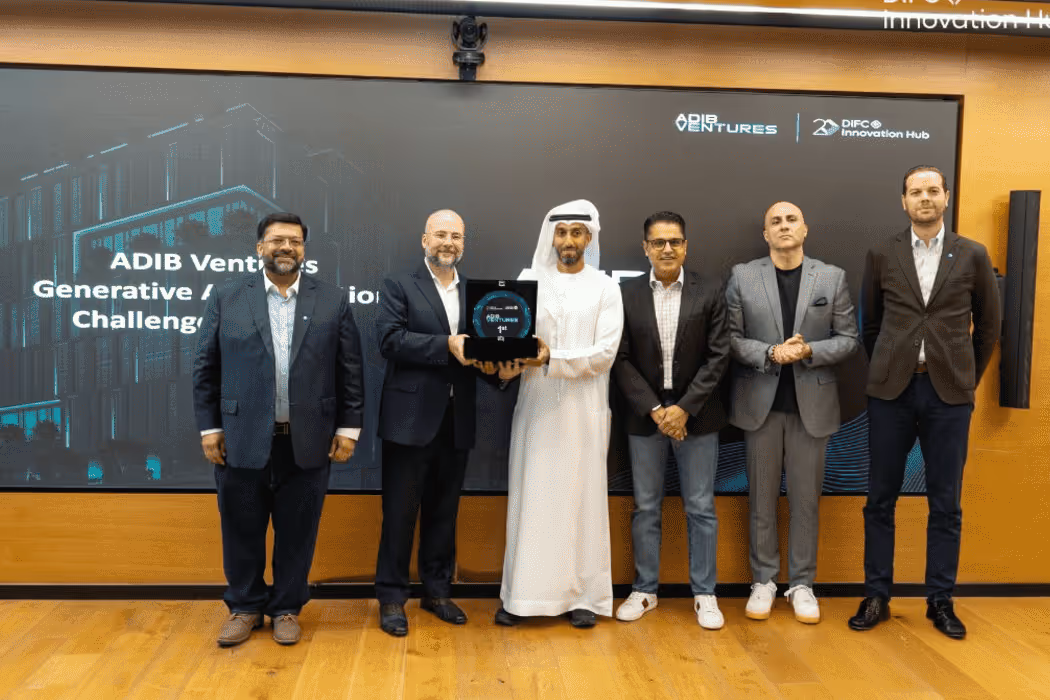
Otera crowned winner of ADIB’s industry-shaping Innovation Programme
The decision came down to a fundamental distinction: other solutions proposed to make existing processes faster, while Otera demonstrated how autonomous agents could execute core banking workflows end-to-end within governed parameters.
When a $34-billion Islamic bank evaluates 60 technology vendors across three continents and selects one, it is not a procurement decision. It is a signal of which operating model the next generation of banks will run on. Abu Dhabi Islamic Bank (ADIB) ran that evaluation through its Innovation Scouting Programme and selected Otera (previously DeepOpinion) as the winner, choosing autonomous operations over 59 alternatives.
A Rigorous, Real-World Evaluation
ADIB's programme moved through three stages. Sixty vendors entered. Internal committees assessed each against a clear bar: could the solution fundamentally change how the bank operates, not just digitize what already exists, while meeting the governance and compliance demands of a regulated Islamic finance institution? Six finalists presented to roughly 30 senior leaders, including five C-level executives.
The other finalists spanned the UAE, Europe, and the United States, each offering capable technology. What separated Otera was an operating model distinction. Where other solutions proposed to make existing processes faster or more accurate, Otera demonstrated how specialized AI agents could execute core banking workflows end-to-end, with humans setting governance rules and intervening only where genuine judgment is required.
"ADIB evaluated 60 vendors and chose autonomous operations. That tells you where banking is heading. Not toward better tools, but toward a fundamentally different way of running the institution," said Stefan Ramershoven, CRO of Otera.
Addressing Core Challenges in Modern Banking
Banks operating at ADIB's scale carry enormous process complexity. Compliance verification, document-intensive onboarding, multi-party exception handling, internal reporting across jurisdictions. Traditionally, these workflows run on large operational teams supported by fragments of automation that still leave humans to reconcile gaps, chase exceptions, and make judgment calls at every decision point. The process stays fundamentally manual. The cost stays fundamentally fixed.
Autonomous operations replace that model entirely. Specialized AI agents collaborate under governance to handle the full process from intake to resolution. Humans define the rules, monitor outcomes, and step in where the situation genuinely demands human judgment. Everything else runs without manual intervention. For institutions processing millions of transactions across multiple countries, this is a structural shift in operating capacity and cost, measured in the hundreds of millions over a transformation cycle.
A Milestone for the Banking Industry
ADIB's decision carries weight beyond its own operations. Regulated financial institutions have historically moved cautiously on automation, and for good reason. The processes that matter most are the ones full of exceptions, regulatory nuance, and multi-system complexity. These are exactly the processes that previous generations of automation tools could not touch.
That barrier is what makes ADIB's selection significant. This is a bank with over one million customers, more than 60 branches, and operations spanning six markets choosing to move from assisted automation to autonomous operations. Other institutions evaluating their own transformation programs now have a reference point. The question is no longer whether autonomous operations can work in regulated banking. It is how quickly the rest of the industry will follow.
About Abu Dhabi Islamic Bank (ADIB)
ADIB is a leading Islamic bank headquartered and listed in Abu Dhabi, UAE. The bank holds $34 billion in assets and serves over one million customers across more than 60 branches in the UAE, with a presence in six strategic markets including Egypt, the Kingdom of Saudi Arabia, the United Kingdom, Qatar, Sudan, and Iraq.